



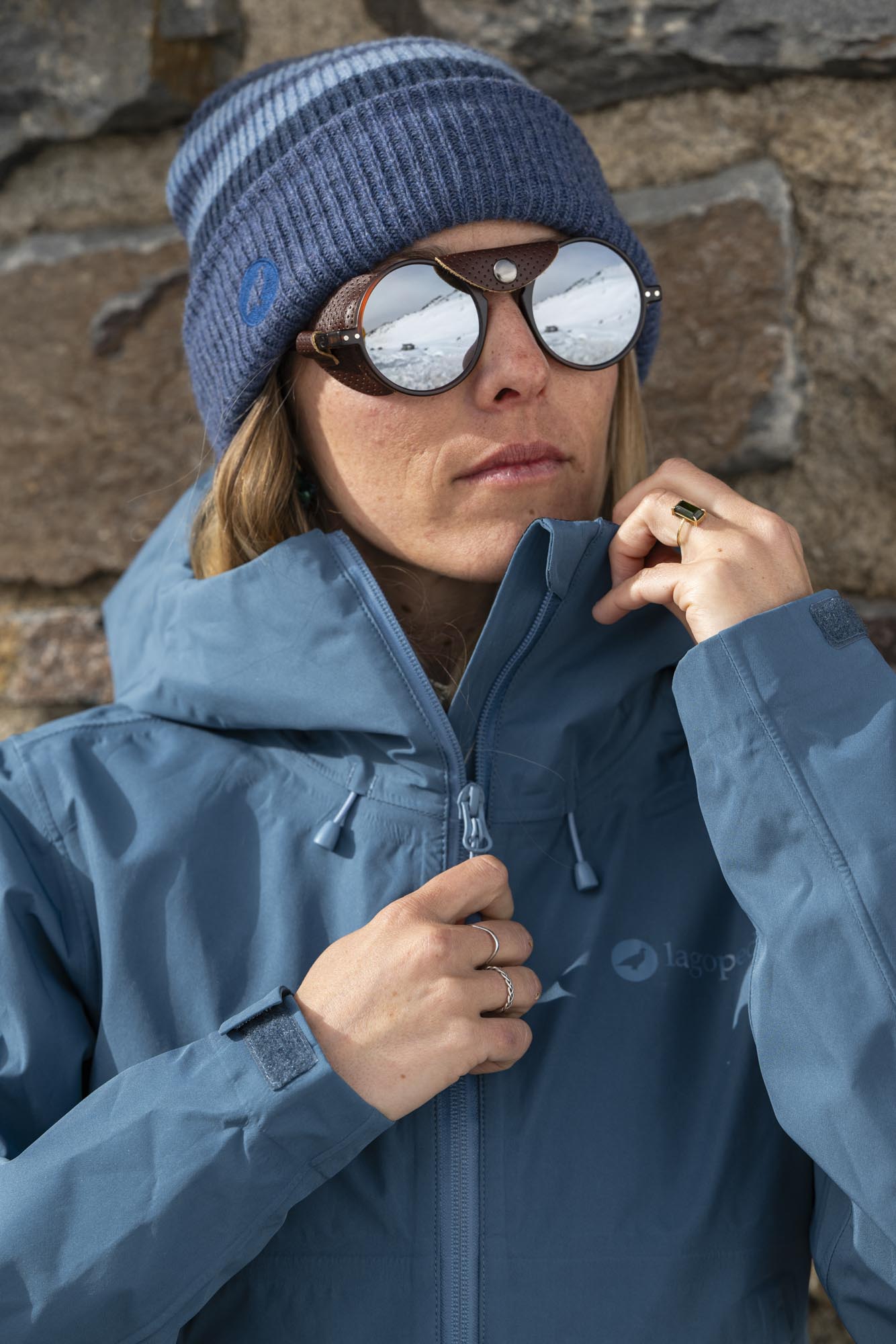

PFAS-free clothing: why Lagoped refuses these pollutants
|
|
On February 20 last, the National Assembly adopted a law aiming to gradually ban PFAS, these "forever pollutants" that permanently contaminate our environment and our health. Led by the Green Party deputy Nicolas Thierry, this text notably provides for the ban of several products containing PFAS by 2026 and 2030, such as textile products containing PFAS by January 2030, except for certain categories of textiles for professional use. A major step forward that reflects growing awareness of the dangers of these substances. This law makes France one of the pioneering countries in Europe on this issue.
Per- and polyfluoroalkyl substances, better known by the acronym PFAS, are a family of more than 10,000 synthetic chemical compounds. Used since the 1940s in industry for their non-stick, water-repellent, and stain-resistant properties, they are omnipresent in our daily lives: food packaging, firefighting foams, pan coatings, and of course, technical clothing.
The major problem with PFAS? Their extreme persistence in the environment. Once released, these molecules do not degrade, or degrade very slowly, and accumulate in water, soil, and the food chain, with serious consequences for human health and ecosystems. Once emitted, these pollutants remain present for hundreds, even thousands of years.
The carbon-fluorine bonds that make up PFAS are among the strongest in organic chemistry. This resistance makes them practically indestructible in nature, where they migrate over long distances, contaminating rivers, groundwater, and agricultural land. According to several studies, these pollutants are found in drinking water and the food we consume.
After observing the concentration of PFAS in our environment, there is no longer any doubt: the "forever pollutants" are a real danger to living beings and especially to humans. Indeed, exposure to PFAS is associated with a growing list of chronic diseases and toxic effects:
Cancers (kidney, liver, testicle)
Hormonal disorders and infertility
Altered neurological development in children
Weakened immune system
The most exposed populations are chemical industry workers, professionals handling these substances, and residents near heavily contaminated areas, called "hot spots."
The use of PFAS has exploded over past decades despite scientific warnings. Here is a timeline of the main stages of this environmental scandal:
1940s-1950s: In the United States, the company 3M begins PFAS production for various industrial applications.
1960s-2000s: Massive expansion in textiles, coatings, and food packaging.
1997 : Kris Hansen, an employee of the 3M company producing PFAS, discovers large-scale contamination (Minnesota, USA).
2000s: The health scandal breaks out in the United States when lawyer Robert Bilott investigates the environmental dumping by the DuPont group of thousands of tons of sludge containing PFOA. In the early 2000s, the company 3M announced the end of PFOS production after its health impact was revealed.
2001: The Stockholm Convention begins regulating these persistent organic pollutants, including several compounds from the PFAS family.
2009 : PFOS - perfluorooctanesulfonic acid, classified as possibly carcinogenic by the International Agency for Research on Cancer, is banned in Europe.
2012 : Tefal, the French brand manufacturing non-stick pans, claims to have stopped using PFOA in its production and at its factory located in Haute-Savoie, in Rumilly. A region heavily polluted by PFAS.
2019 : PFOA, a widely used PFAS, is banned in Europe after being classified as carcinogenic.
2020: Europe regulates the monitoring of PFAS in drinking water.
2022: 3M announces the end of its PFAS production by 2025, under regulatory pressure and health concerns.
2023 : Fluoropolymers are classified as carcinogenic to humans.
February 2023: uPFAS - project for a “universal restriction” of PFAS. Publication of a European draft ban on all these forever pollutants: Germany, Denmark, Norway, the Netherlands, and Sweden propose a text that would affect the entire chemical universe of PFAS at once, i.e., more than 10,000 substances.
February 2025: adoption of a law aiming to gradually ban PFAS by the National Assembly (France).
2026 : possible entry into force of the uPFAS project, delayed due to an intense lobbying and disinformation campaign led by PFAS-producing and using sectors.
Faced with regulatory pressure, industries have introduced new forms of short-chain and ultra-short-chain PFAS. These molecules, supposed to be less harmful, are actually more mobile and harder to clean up than their predecessors. Far from providing a solution, they prolong widespread contamination.
Europe has identified at least 23,000 sites contaminated by PFAS. Their cleanup represents a major technological challenge: the only effective solution is to burn these substances at over 1,100 °C in specialized incinerators. According to an estimate by the Forever Lobbying Project, the total cost of decontamination could reach between 95 and 2,000 billion euros over 20 years for the European continent.
Why such a difference in the estimated cost of cleanup? In an optimistic but unrealistic scenario where all PFAS emissions would stop tomorrow, the cleanup would cost "only" 95 billion euros. The more realistic scenario of 2,000 billion euros, however, does not take into account the impact on countries' healthcare systems and negative externalities.
If the polluter pays principle is not applied, the cost will be passed on to consumers. Each European household could pay 480 euros per year to remove PFAS from drinking water. An exorbitant cost that highlights the urgency of banning these substances at the source.
Outdoor clothing is among the first to be affected by the use of PFAS, especially in membranes and water-repellent treatments. Indeed, one of the PFAS that has made headlines in recent months is a product used in cookware or water-repellent & waterproof jackets. These are fluoropolymers, a category of "high-performance" PFAS, whose water-repellent or non-stick qualities are exceptional.
But at Lagoped, we have made a radical choice: no PFAS in our products, and this has been the case since the brand was created.
We work with committed partners like Sympatex, which offers waterproof and breathable membranes without fluorine. Our water repellents come from alternative technologies that are environmentally friendly, ensuring effective protection without impacting the health of our customers or the planet.
To maintain the effectiveness of water-repellent clothing, we encourage our customers to care for their technical jackets and pants by maintaining their water repellency with a water-repellent spray, which of course contains no PFAS.
PFAS pollution is a major environmental and health crisis, the full extent of which is only beginning to be understood. At Lagoped, we refuse to wait for regulations to enforce change: we have chosen to design technical clothing without PFAS, healthier and more durable.
Changing our consumption habits is essential. As a consumer, choosing PFAS-free alternatives actively contributes to more responsible fashion.
To encourage transparency and accurate information for our readers, we provide the readings that allowed us to write this summary article. We encourage you to understand the importance of PFAS pollution for yourself through the following sources.


