



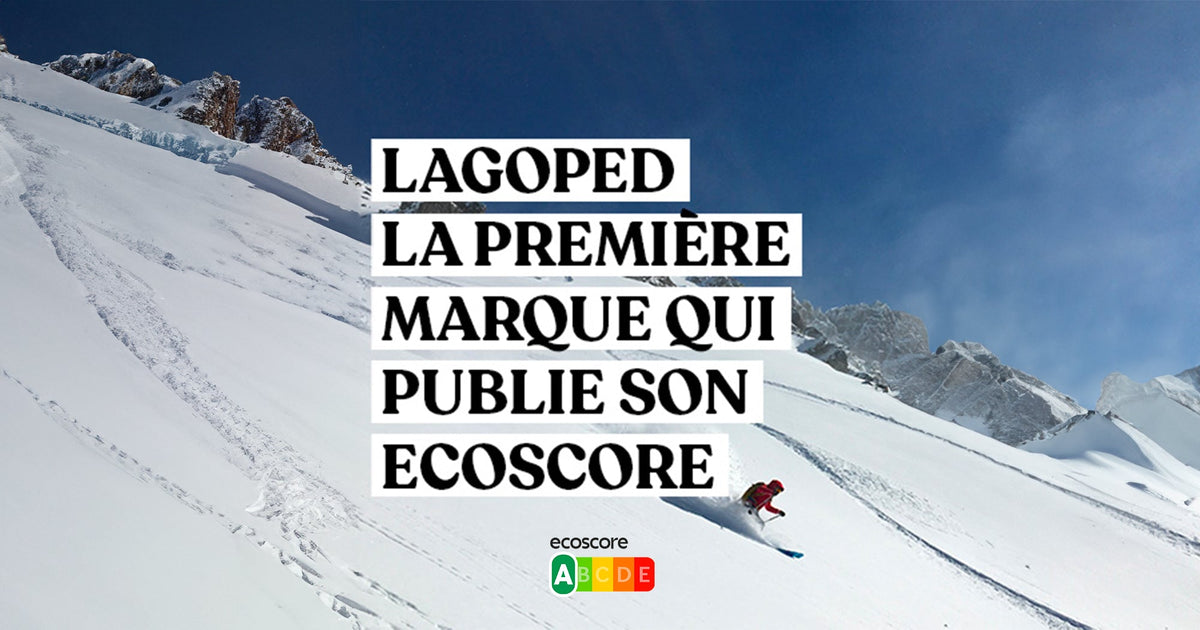
Lagoped publishes its French eco-score on its entire collection
|
|
No less than 5 days after the presentation of the new French eco-score by the Ministry of Ecological Transition on April 3, 2024, Lagoped had already published all the "ecobalyse" scores for all its products online. Let’s revisit this new French environmental labeling intended for textile products and Lagoped’s commitment to transparency and full traceability of its products.
The eco-score, at the heart of current environmental concerns, positions itself as a crucial pillar in evaluating the ecological performance of textile products. For Lagoped, adopting environmental labeling represents much more than a simple commercial approach. Indeed, this initiative aims to guarantee the effectiveness of the brand's production methods from an ecological standpoint while ensuring transparent and accessible communication to consumers regarding the environmental performance of its products.
This large-scale project, underway for a year and a half already, is part of a cross-cutting approach requiring a rigorous methodological framework as well as a reliable and verifiable database.
By promoting informed and responsible consumption, this eco-score serves as a trusted tool, allowing customers to guide their choices towards virtuous products. However, for this approach to be truly effective, it is essential to ensure comparability between brands and products, thus requiring the establishment of a common database shared by all manufacturers. In this respect, the textile industry is offered a unique opportunity to rethink its production practices, placing traceability and transparency at the heart of its operations.
The French textile industry is facing an urgent need for reform, confronted with figures that highlight its devastating impact on the environment. With no less than 3.3 billion textile items sold on the French market in 2022, the ecological consequences of this industry are alarming. Indeed, according to data from the Ministry of Ecological Transition from 2023, this industry generates a quantity of greenhouse gases exceeding the combined total of international flights and maritime traffic, in addition to consuming 4% of the world's drinking water.
The eco-score, presented in early April 2024 by the Ministry of Ecological Transition in collaboration with ADEME, emerges as an urgent response to these environmental challenges. Named "Ecobalyse," this new calculation tool is based on the European Product Environmental Footprint (PEF), enhanced with additional criteria for a more comprehensive evaluation. French industries, brands, and associations are thus invited to contribute to this initiative before its planned implementation in autumn, with possible mandatory application from 2025. The goal is twofold: to inform and raise consumer awareness about the environmental impact of their purchases, while encouraging a transition to more sustainable practices, notably by penalizing "fast fashion" brands.
Despite progress, challenges remain regarding the implementation of the eco-score. The complexity of value chain traceability makes environmental labeling difficult to obtain for many brands, while the textile sector remains largely fragmented and international. However, pioneering brands, including Lagoped, have already adopted this approach, showing full transparency to their customers.
However, this raises questions about the valuation of recycled materials and the need for a more understandable evaluation system for consumers, similar to the European eco-score with a display akin to the nutri-score. In short, the eco-score represents a crucial step towards a more responsible textile industry, but its effective deployment requires close collaboration between sector players and adaptation to real-world conditions.
Lagoped, concerned about its ecological footprint, has taken a giant step towards transparency in partnership with Peftrust to make the eco-score of its products available on its website. This strategic collaboration is based on the rigorous life cycle analysis method implemented by Peftrust. We wish to express our deep gratitude to Peftrust for this innovative and beneficial initiative for the textile industry.
Peftrust, a SaaS software platform specializing in fashion, outdoor goods, and household items, stands out for its ability to verify and analyze product data in the textile industry, thus providing an environmental score compliant with PEF standards established by AFNOR. PEF, acronym for Product Environmental Footprint, is a European regulation that guides the assessment of the environmental impact of products throughout their life cycle.
This platform, upstream, collects data provided by the brand and its suppliers, cross-references it with a comprehensive database on textile products, and then analyzes it in light of specific impact factors. Thus, it assigns products an eco-score in accordance with the requirements of the European PEF regulation. However, data quality is a crucial issue in this process. It is imperative that data be structured and that communication processes between suppliers and customers be smooth and automated to ensure a reliable and credible score for all stakeholders. Thanks to this partnership with Peftrust, Lagoped is committed to providing transparent and reliable information to its customers, thereby helping them make informed and responsible choices.
The EVE jacket is a historic product in the Lagoped wardrobe, as it has been renewed every year since 2018, and in several colors. For example, to calculate the eco-score of our waterproof jacket, it is necessary to know the impact of its production on climate change, such as water consumption or land use, as well as its composition. According to the Peftrust method, the eco-score is also calculated based on the traceability of materials and each stage of manufacturing (spinning, weaving, dyeing, and tailoring). It also takes into account the impact on human health, natural resources, and the ecosystem.
The European score and the French score can be calculated from all this information and compared to the impact of a reference product.
Thus, the European eco-score of the EVE jacket is 2389 points, compared to a score of 12,251 points for a reference jacket. On the French eco-score side, the score is significantly higher, at 2824 points.
Lagoped launches a communication campaign on its social networks, highlighting the importance of the eco-score in the textile industry. This initiative aims at several strategic objectives, including distinguishing itself from competitors by affirming its commitment to traceability and transparency. Lagoped also seeks to popularize the use of the eco-score in the textile field, emphasizing that knowing the environmental impact of what we wear should be as obvious as knowing what we eat.
As a pioneer in this field, Lagoped proudly positions itself as the first brand to publish its eco-score, in accordance with the European Commission's methodology (PEF), thereby strengthening its reputation as a transparent and responsible brand. This campaign is based on strong arguments, reminding that the textile industry is one of the most polluting in the world, with 90% of its environmental impacts concentrated in the raw material sourcing phase. Lagoped emphasizes that its clothing is made from recycled materials and produced in Europe, adopting a sustainable and ethical approach that breaks with the traditional logic of natural resource extraction. By highlighting these elements, Lagoped encourages collective awareness about the importance of knowing the origin and ecological impact of our clothes, while urging other industry players to follow its example for more responsible fashion.
December 2021 - The European Commission adopts a recommendation on the use of environmental footprint methods.
March 2023 - Lagoped becomes the first French textile company to have published its eco-score for all its products according to the European Commission's method.
April 2024 - The French Ministry of Ecological Transition presents its new eco-score, developed with ADEME.
April 2024 - Lagoped becomes the first French textile brand to publish the eco-score of its products according to the Ministry of Ecological Transition's method


