




My first ultra-distance bike ride on the Desertus Bikus
|
Cart
To go further:
|
Crossing Spain by bike, between Pyrenean peaks and endless plains, is the adventure I chose for my first ultra-distance challenge.
Ultra-cycling isn’t just about numbers or kilometers; it’s a dive into the unknown. For my first big leap, I chose the Desertus Bikus, a 1200 km race with 16,000m of positive elevation, crossing Spain. Living in the Basque Country and having lived in Spain, this terrain felt like an obvious choice. I wanted to see behind the scenes, far from cities, where the wind and asphalt rule.
I’m often asked: “Why put yourself through this?” The answer is multifaceted. There’s the physical challenge, of course, but above all the joy of travel and sharing. In an event like the Desertus Bikus, you start alone against your route, but you always end up sharing a café con leche or a stretch of road with other enthusiasts. Whether aiming for pure performance or simply to finish within the 7-day limit, each participant experiences a unique inner journey, and that’s exactly what I came for.
Table of contents
An adventure of this scale can’t be improvised. While some rely on physical or mental coaches, I chose autonomy. My strategy? Maximize saddle time throughout the winter, with one guiding principle: enjoyment. To last the distance, desire must always outweigh obligation, in my opinion.


The goal was simple: spend as much time as possible on the bike, no matter how I felt.
The key advice:
Nothing beats traveling on the road. I organized several micro-adventures lasting 2 to 3 days to test my gear in real conditions, get used to the weight of the loaded bike, and refine my nutrition strategy as well as my recovery rhythm. Next time, I’ll go up to 4 days for better preparation.
Ultra cycling doesn't just challenge the legs. I incorporated targeted muscle strengthening to protect my back, neck, shoulders, and arms. It's this overall core strength that helps maintain posture despite fatigue.
Finally, the essential step was the posture study. Spending two hours adjusting every setting according to your morphology and flexibility is not a luxury: it’s the guarantee to transform the machine into an extension of yourself and avoid repetitive injuries.
For this journey, I wanted to prioritize European and local manufacturing. My bike is fitted with tires made in France and equipped with bags handmade in Ariège and front and rear lights produced in the Pyrénées-Atlantiques. I was also equipped with a headlamp made in a workshop located in Burgundy, and a saddlebag made in Germany. To learn more about the equipment, see the end of the article.
On the textile side, I picked from Lagoped's gravel wardrobe to complete my gear:
The technical KEA sports bra. In ultra, the slightest friction becomes a torment. The softness of the fabric and the absence of shoulder compression allowed me to completely forget it for 4 days.
The light MESDALG shirt, lThe favorite piece to break the "total lycra" look often seen in cycling. Lightweight and breathable, it offers an elegant style during breaks while perfectly protecting the back in the riding position.
The UKPIK softshell jacket. Essential for early starts and cool nights. Its windproof effect is impressive.
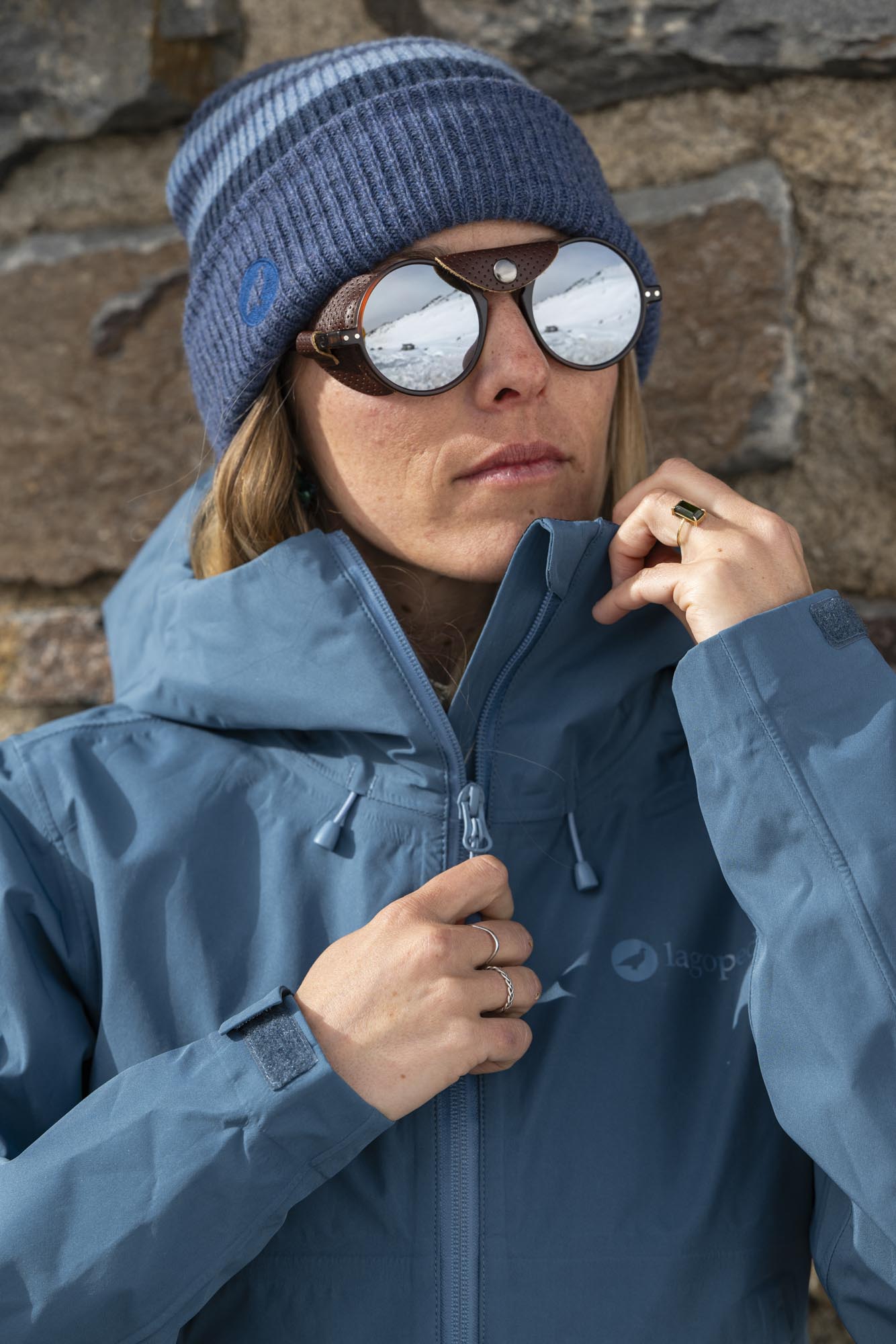
The waterproof TETRAS jacket. It saved me during the hailstorms in Castile. Its underarm vents and long cut in the back make it a valuable ally to stay dry without suffocating. I wear it in all seasons and it was very useful during winter preparation.
The atmosphere in Hasparren is electric. Between the notes of the Basque Banda and the last mechanical check-ups, the nervousness is palpable.
Midnight. The pack of 400 cyclists takes off. Quickly, the road becomes a ribbon of light. I ride with Agathe and Baptiste.
The first stroke of bad luck strikes after 35 minutes: Baptiste's derailleur cable snaps. Fortunately, I have a spare cable in my mechanic's kit. We try a rescue in Saint-Jean-Pied-de-Port, but the cable head is stuck. We head back up the Ibañeta pass while almost all the participants have passed us. The 18 km climb is done to the sound of music to forget the fatigue of the days before the start, avoiding toads crossing our headlights.
After crossing the Ibañeta pass in the night fog, Spain welcomes us with green landscapes reminiscent of the English countryside. After a freezing descent and a quick repair in Pamplona, we head towards Soria. The road is long but offers wonderful surprises for the eyes.
The reality of ultra catches up with me that very evening: the last 40 kilometers to Soria are ridden under a threatening storm, alone in the dark. It is there, in fear and fatigue, that I touched my first limits. Summary of the first day: 300 km, an absolute record for me.
On the second day, waking up is brutal and the legs are heavy. After a late start and two hearty Spanish breakfasts, we check in at CP1 at Castillo de Atienza. This stone village is a haven where we share our first anecdotes with other participants. It is also where the beauty of the landscape takes on its full meaning, despite a hailstorm forcing us to take shelter in a makeshift refuge. We park the bike after 155 km, a necessary "recovery" day for what lies ahead.
On the third day, we opt for an earlier wake-up. We begin crossing the Madrid region. Here, the landscape changes drastically: long endless straight lines as far as the eye can see. The mind must take over from the legs. It is here that we meet a group of cyclists, including Michel, 66, a Belgian ultra veteran whose kindness is a true balm.
It is also the moment when a sharp pain appears in the groin, probably caused by repeated friction between the saddle and the shorts worn (from another brand). Every pedal stroke becomes a challenge against this friction. Despite this, I escape by singing at the top of my lungs and counting rabbits along the roads of Castile-La Mancha. We reach the hotel after 225 km. The physical toll is heavy: the wound is there, and it has no intention of going away.
Waking up at 4 a.m. is the hardest. Deep down, I know these kilometers will be the last. I fight the pain, my speed drops, the pleasure fades. I say goodbye to Baptiste one last time at the top of a hill, wishing him to reach CP2 that very evening.
At kilometer 714, in Ossa de Montiel, I get off the bike. The skin wound is too deep. Emotion explodes. While recording a voice message for my loved ones, I break down in tears. The adventure ends here. This is not a failure, it is a learning through the body. I have discovered my limits, tested my resilience, and I already know I will come back.
I load the bike into the rental car driven by my friend Eugénie, photographer and videographer, and head to CP2 then CP4 and the finish line to cheer on the other participants. Huge congratulations to all finishers and non-finishers alike!
To endure an ultra-cycling race without major incidents, component choice is crucial. Here are the details of my setup for this Desertus Bikus.
Beyond component choice, peace of mind comes from flawless mechanics. Throughout my preparation and just before the big start, my bike received regular tune-ups at my favorite bike shop. It’s a reassuring ritual that helps anticipate any invisible wear.
Frame: TREK DOMANE SL5 (2024). An endurance carbon frame, ideal for absorbing vibrations over 1200 km while staying under 9 kg.
Groupset: Complete Shimano 105. Reliable, precise, and easy to repair anywhere in Europe.
The secret to a clean drivetrain: before departure, I meticulously cleaned the chain and cassette. Given the sunny and dry weather forecast, I opted for a hot wax treatment. Result: a smooth, quiet drivetrain that doesn’t attract trail dust.
Tires: Hutchinson Caracal 35mm, Tubeless Ready setup. A wide section for comfort on trails without sacrificing performance on asphalt. Zero punctures over the 714km of my ultra.
Cockpit: Added ZIPP extensions to vary positions and relieve wrists and back on long straight stretches.
Bike lighting: KLAMP brand (Pyrénées-Atlantiques). At the front, a 1600lm kit with a remote 5000mAh battery mounted on the extensions. At the rear, the RX500 lamp fixed to the bag. Essential for riding safely at night.
KISKA 3 headlamp from the brand Stoots, made in Burgundy. It provides better visibility in turns and on the bike.
Work on the route! Don’t underestimate the elevation gains at the end of the day. Be flexible to adjust your stops based on how you feel.
Long-duration testing is essential! Before your first ultra, do a "gear test" weekend. Load your bike exactly as for the race and ride for three consecutive days. That’s when you’ll detect saddle or adjustment issues.
Nutrition is strategic! Don’t rely solely on gas stations, even though there are many along the route. I had dried mangoes and Cooknrun bars with me, healthy products my body knows. It ensures stable energy without a sugar crash. Test during your preparation the nutrition that suits you best!
Start small. To get started, organize your first bike weekends and try your first BRMs (Brevets de Randonneurs Mondiaux). It’s ideal to make sure you enjoy spending so much time in the saddle.
Despite the premature stop, I keep only the positive: the laughs and kilometers shared with Agathe and Baptiste, the kindness of cyclists and Spaniards met along the crossing, and the pride of having proudly represented Lagoped on Spanish roads. Ultra cycling is a school of humility. I already know which adjustments to try on my positioning and equipment to come back stronger.
Ready to take on the adventure?
Enora Gelot
Former Marketing Manager at Lagoped between 2024 and 2026, Enora started road cycling in 2019. In 2025, she signed up for her first ultra bike event after taking on the Mont Ventoux challenge with friends. Through this kind of adventure, she loves above all the experience, travel, sharing, and enjoyment.


