



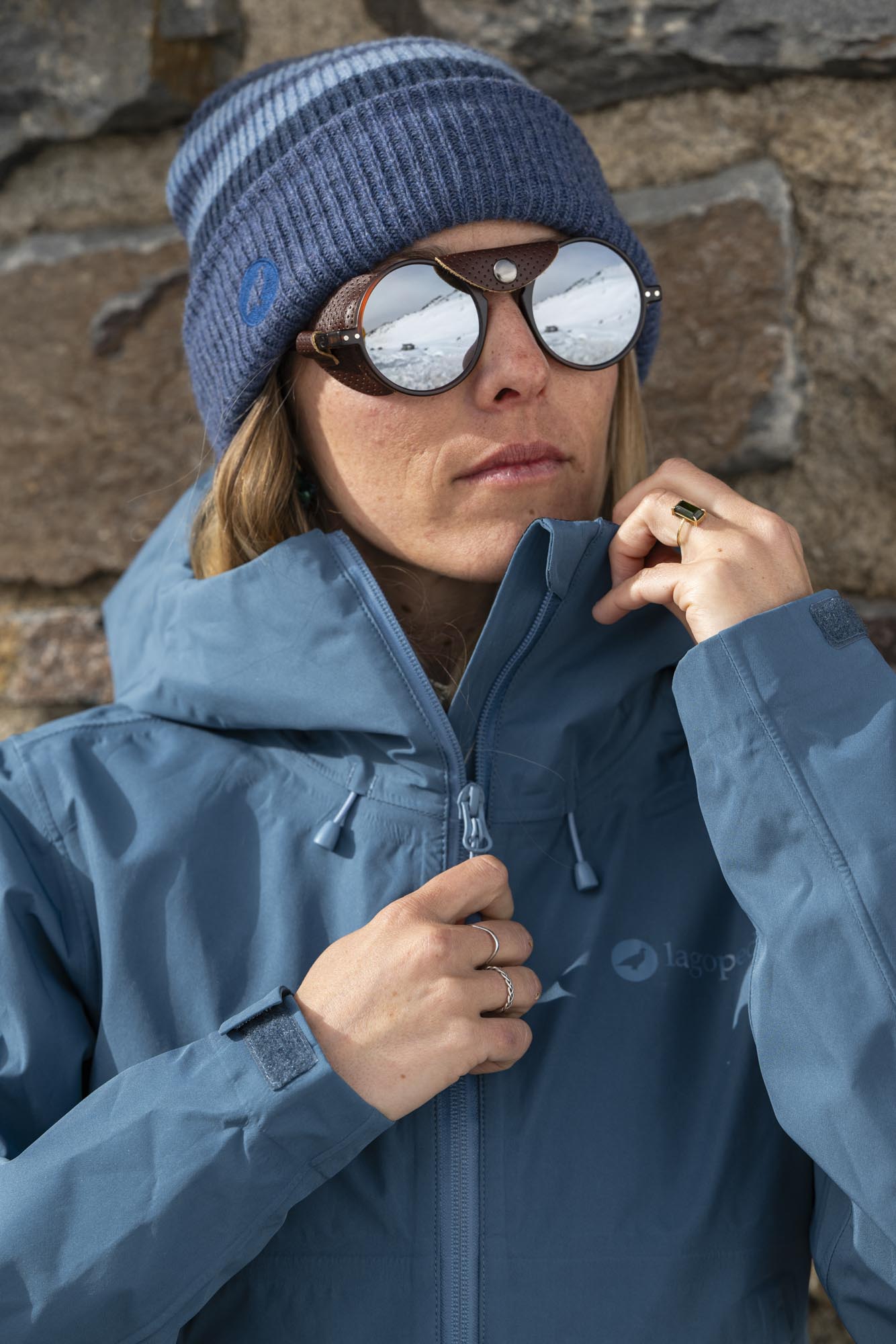

What is the eco-score for our outdoor clothing? Lagoped takes stock
|
|
The ecological transition of the textile sector requires better consumer information. However, when it comes to assessing the environmental impact of a garment, the diversity of tools available can be confusing. In recent years, several initiatives—in France and across Europe—have attempted to propose a textile eco-score : a clear, unique, and standardized indicator to guide more responsible choices.
Inspired by the nutri-score or the energy label, these scores condense a life cycle analysis (LCA) into a score from A to E. The objective: to allow everyone to easily compare the environmental impact of two products, while encouraging the industry to design more virtuous clothing.
But in this period of transition, between the European method (PEF) still in evolution and the French methodology in the process of being finalized, it is essential to understand the differences. And to know how a brand like Lagoped , committed to more sustainable textiles, is using these tools to offer more transparency.
Lagoped is the first French textile brand to display an eco-score on all of its clothing.
As of 2023 , we adopted the PEF (Product Environmental Footprint) method, a European environmental assessment framework. Then, in 2024 , we switched to the French method based on the Écobalyse database, in accordance with the decree currently being adopted. This pioneering choice reflects our commitment: to make the impact of each item of clothing visible and understandable.
But what exactly are we talking about? And what is behind these environmental ratings?
Textiles is one of the most polluting sectors in the world. It uses enormous volumes of water, energy, and raw materials, while generating waste, microplastics, and greenhouse gas emissions. It is therefore essential to produce better, but also to choose better .
Eco-scores attempt to answer this question by synthesizing all of a product's impacts into a readable score. To do this, they rely on a life cycle analysis (LCA) : from the cultivation of the raw material to the manufacturing, use, and even the end of the garment's life.
But not all evaluation methods are equal. Two approaches coexist today:
The PEF method, developed by the European Commission;
The environmental cost , carried by France through the Écobalyse database.
The Product Environmental Footprint (PEF) method was developed by the European Commission to provide a common scientific benchmark for all products. It is based on 16 environmental indicators : climate change, human toxicity, acidification, land use, water pollution, etc.
It uses a dedicated database ( EF v3.1 ), and its calculation is based on technical data, resulting from very detailed life cycle analyses.
The PEF remains a voluntary framework today, mainly used in B2B relations or in the context of European calls for projects. A revision is planned for 2026–2027 , in particular to integrate emerging issues such as microplastics or biodiversity .
In France, brands are not allowed to display an overall score based on the PEF in their communications to the general public. Only raw indicators such as carbon footprint or water consumption can be published.
At the same time, France has developed a more direct approach, with a clear objective: to make environmental impact readable for all . This method, called "environmental cost" , is based on the Ecobalyse database, which is open and public.
It uses 14 environmental indicators , including carbon footprint, water used, abiotic resources and environmental pollution. Its calculation is simpler than that of the PEF: you just need to know the composition , the weight of the product and the locations of the main manufacturing stages (spinning, weaving, dyeing, assembly).
Special feature : this method takes into account extrinsic sustainability , i.e. the economic model of the product (fast fashion vs. sustainable product). It therefore penalizes clothing with a short lifespan or single use.
A decree is expected by the end of September 2025 , from which all environmental communication in France will have to rely exclusively on this method . Eventually, the score will appear directly on the product label.
These two systems are not incompatible. They share a common goal: to encourage the reduction of the environmental footprint of textile products . Eventually, a convergence could occur, but for now, each framework targets a different audience .
Whether using the European PEF method or the French method, the principle of calculating the score is the same:
Score = ∑ (Impact / Normalization Factor) × Weighting Factor
But there are some major differences:
The weightings differ – for example, France gives much more weight to ecotoxicity in fresh water (21.10%) while the PEF method gives more importance to human toxicity and the use of fossil or mineral resources.
The French method adds two criteria : discharges of plastic microfibers and share of exports outside the EU.
The functional unit changes :
PEF Europe: Score / (average number of days of use × intrinsic quality × repairability)
France Method (Ecobalysis): Score / non-physical durability.
The European method takes into account the physical durability of the garment while the French method integrates emotional durability linked to the economic model of the product (fast fashion vs. sustainable production).
At Lagoped , we have been following these developments for several years. In 2023 , we adopted the PEF to assess the environmental footprint of our clothing. In 2024 , we switched to the French benchmark based on Écobalyse , becoming the first French textile brand to display an eco-score on its entire collection .
Why this choice? Because we believe that information, when reliable and understandable, is a powerful lever for consuming better—and producing better.
For us, environmental labeling is not a constraint, but an ethical requirement . It pushes us to design more sustainable clothing, to source recycled or recyclable materials, to favor European partners, and to rethink every detail.
The eco-score doesn't tell the whole story. It doesn't replace common sense or the attention we pay to our clothes. But it does offer a benchmark in a sector that's still too opaque.
At Lagoped, we want every piece of clothing you wear to have meaning—in its function, its use, and its impact. Thanks to environmental labeling, you can now make an informed choice .
And we continue to progress, in complete transparency.
NB: Eco-score ratings are not yet available for all the products in our collections. For transparency, we display the French rating when available and the European rating when the former is not.
 Lagoped publishes its French eco-score for its entire collection
 PFAS-free clothing: why Lagoped rejects these pollutants
 Lagoped against fast fashion: a sustainable model
 PFAS - State of play of eternal pollutants in the textile industry
 Lagoped provides repairs for outdoor clothing


