




5 essential technical clothing items for hiking
|
Cart
To go further:
|
Hiking in summer means enjoying nature at its finest… but also facing highly variable conditions: heat, sudden rain, wind at altitude, or cool nights. To avoid unpleasant surprises, being properly equipped is essential, even for a simple walk in the mid-mountains.
Whether you’re looking for a men’s hiking outfit suited to warm weather or want to complete an already well-rounded kit, the question always comes up: which technical clothes should you pack without overloading your backpack?
And if these hiking clothes are also designed responsibly, even better. Because travelling light also means travelling with a reduced impact.
There’s no need to pile on the layers. With these 5 carefully chosen pieces, you’re ready to set off, whether for a day hike or a multi-day trek.
A good hiking T-shirt is the essential first layer for staying dry and comfortable, even when climbing in 30°C heat. Made from recycled polyester, the TEETREK is breathable, lightweight, and quick-drying. Its technical knit efficiently wicks away sweat.
Designed for active use, the TEETREK is available in a men’s version and a women’s version, with a fitted and comfortable cut. It is made entirely in the European Union, without harmful substances or PFAS, in line with Lagoped’s commitments.
An essential piece, just as useful for a day hike as for a multi-day trek.
When it comes to choosing good men’s hiking trousers or women’s, it’s best to choose a versatile, durable piece that’s comfortable to wear all day. The PTARMIGAN2 ticks all the boxes: recycled stretch fabric, reinforced knees and seat, practical pockets, and an ergonomic fit that moves with you.
These hiking trousers are perfect for summer: they are breathable and water-repellent in light showers, and effectively protect against scratches from branches and high-altitude winds. They are woven, dyed, and assembled in the European Union.
A durable hiking garment designed to last and adapt to every adventure, from family walks to long-distance trails.
In summer and during the shoulder seasons, a technical fleece remains an essential in your backpack. It insulates against the cold while staying lightweight, breathable, and compact. At Lagoped, the PHANTOM models (unisex, with or without a hood) and GELINOTTE (women’s, with or without a hood) each offer an excellent warmth-to-weight ratio.
Made from recycled materials, without any harmful chemical treatments, these technical fleeces are produced in Europe, following the principles of local, responsible manufacturing. Their minimalist design makes them suitable for both hiking and everyday wear.
An essential mid-layer for facing a cool wind on a ridge or taking a picnic break in the shade of a summit.
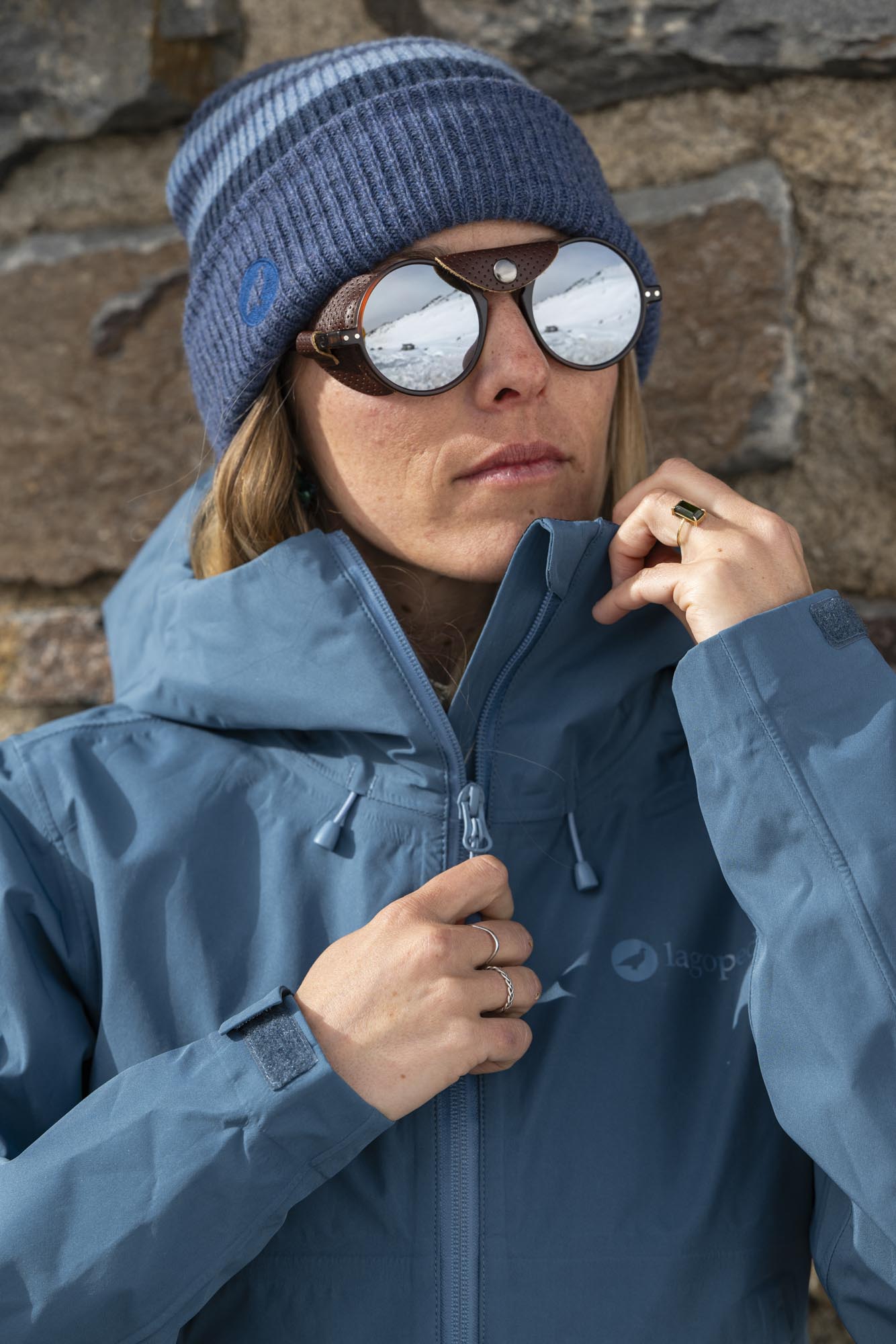
Even in summer, it is essential to pack a waterproof hiking jacket in your backpack. Mountain weather can change within minutes, and a shower or thunderstorm can quickly roll in. The TETRAS, a three-layer technical jacket, provides 20,000 mm waterproofing, optimal breathability, and technical details suited to hiking: an adjustable hood, large zippered pockets, underarm ventilation…
Made from recycled materials and without PFAS, the TETRAS is woven and dyed in France, Italy, and Austria, then assembled in Poland. Available in men’s and women’s versions, it is a technical garment designed to last, be repaired, and be passed on.
A safe choice for anyone looking to equip themselves sustainably with a high-performance hiking garment.
Good hiking gear doesn’t stop at clothing. Some well-chosen accessories can really make a difference on the trail.
The WINSNOOD neck warmer, lightweight and multifunctional, protects against the sun, wind, or cold depending on the conditions. Made in Europe from recycled microfibers, it easily slips into a pocket or around your wrist.
The LAGOBI bottle, developed with Gobi, is lightweight (130 g), durable, BPA-free, and made in France. Its 1 L capacity is perfect for staying hydrated on the move.
The GEBO beanie, made from fine recycled knit fabric, is compact and ideal at high altitude or when bivouacking.
Small items that take up little space but make hiking much more enjoyable and safer.
Preparing for summer hiking does not mean compromising between performance, comfort, and environmental impact. On the contrary, choosing the right women's hiking clothing or men's hiking clothing not only allows you to enjoy the trails more, but also to commit to a more sustainable outdoor practice.
To find out how to dress for summer hiking according to altitude and weather, our comprehensive guide how to dress for hiking explains the three-layer system and the right habits for different conditions.
At Lagoped, every piece is designed to meet the demanding needs of hikers: recycled materials, manufacturing in the European Union, no PFAS, and long-lasting durability. From technical T-shirts to three-layer waterproof jackets, as well as hiking pants and lightweight accessories, the entire wardrobe is designed to be high-performing, versatile, and respectful of the planet.
In the mountains, temperature variations can be significant over the course of a single day: from -5°C early in the morning to over 25°C in direct sunlight, depending on altitude .
At dawn, especially above 2,500 meters, the thermometer can drop below zero.
In the middle of the day, temperatures often reach 20 to 25°C even at high altitude, if the sun is out.
In the evening, or if the wind picks up, the air quickly turns cool.
To cope with these variations, it is recommended to layer several garments: a technical T-shirt, a warm layer such as a fleece, and a windproof or waterproof jacket. This makes it easy to adjust your level of protection throughout the day.
It is entirely possible to hike in regular sportswear, provided it is breathable, comfortable, and suited to physical activity. However, not all sportswear is designed to cope with the varied and sometimes unpredictable conditions found in the mountains.
A good hiking garment should be:
Breathable, to wick away perspiration,
Quick-drying, to prevent the post-exercise “cold” feeling,
Durable, particularly against backpack abrasion and the elements,
Compact, to fit easily into a backpack,
Versatile, to adapt to different types of activities.
🧵 Lagoped’s clothing range is designed for multi-activity use. A waterproof jacket can protect you just as well in the mountains as on a bike; technical trousers will be just as comfortable at a bivouac as during a climb. Durable, versatile clothing designed to last and adapt to different uses.
The choice of jacket depends on the weather conditions, terrain, and intensity of the activity. In summer, it is best to choose a garment that is lightweight, breathable, and protective, as conditions can change quickly in the mountains.
Here are three technical options suited to different situations:
The three-layer waterproof jacket, such as the TETRAS, provides reliable protection against rain and wind. Lightweight and compact (under 500 g), it is easy to carry in a backpack and quickly becomes indispensable in the event of a sudden storm at 2,500 m altitude.
The windbreaker, such as the NAGALAKA, is ideal for hikes in dry but exposed conditions. Ultra-lightweight, it effectively blocks the wind at altitude or on ridgelines while ensuring good breathability.
The softshell, such as the UKPIK, is perfectly suited to early-morning starts or cooler days. Water-repellent, flexible, and breathable, it provides thermal comfort without being as warm as a down jacket.
🔁 All Lagoped jackets are designed to last, be repairable, and be made with recycled materials in Europe.
The weight of the backpack depends on the length of the hike:
For a day hike, it is recommended not to exceed 10% of your body weight, or approximately 5 to 7 kg for an adult. This includes water, a picnic, a warm layer, a first-aid kit, and a few useful accessories.
🏕️ For a hike lasting several days, your pack can weigh up to 15% of your body weight, or 8 to 12 kg. Ideally, prioritize versatile, compact, and lightweight clothing and equipment.
🎯 At Lagoped, clothing is designed to be functional, versatile, and easy to pack, with no compromise on technical performance.
Cotton may seem like the obvious choice in hot weather: it is natural, breathable when stationary, and pleasant to the touch. But it is the riskiest material for technical hiking. Cotton absorbs sweat without wicking it away: when wet, it remains heavy and cold against the skin, promotes chafing, and can cause hypothermia even in summer if the wind picks up or the weather deteriorates at altitude.
The rule in the outdoor world is simple: no cotton as a base layer once you move beyond a short walk on safe terrain.
For a technical and lightweight men's hiking outfit, recycled polyester or recycled polyamide are the go-to materials: they wick away sweat, dry quickly, and retain their properties even when wet.
💡 This is the choice made across the entire Lagoped range, manufactured in Europe made from 100% recycled materials, without PFAS.
In the mountains, UV ray intensity increases by around 4% for every 300 meters of elevation gain. At 2,000 meters, it is already 27% higher than at sea level, and reflection from snow or light-colored rocks further increases exposure. A standard hiking T-shirt offers very limited protection: standard white cotton has a UPF rating of 5 to 8, allowing between 13% and 20% of UV rays through.
☀️ For a men's hiking outfit exposed at altitude, UPF 50+ certified garments such as the TEETREK or PTARMIGAN2 protect covered areas without requiring sunscreen to be reapplied every two hours. To understand how this protection works and what the certification really guarantees, our complete guide to UPF 50+ UV-protective clothing explains the four manufacturing techniques and the EN 13758 standard.


