




Chartreuse, Italy, Sicily, Sardinia, Corsica: five weeks cycling with Charlotte and Nicolas
|
|
Some trips are planned. Others are improvised on the margins of a bigger project. For Charlotte and Nicolas, this departure on April 24, 2026, is both. Five weeks, Chartreuse as the starting point, Turin as the first stage, and all of Italy to cross to Corsica. The official goal: to test the equipment that will be used for season 2 of RISE, a series of documentaries filmed by bike meeting communities who live differently. The unofficial goal: to live, pedal, fly, meet.
To last the distance, they needed sturdy bikes capable of carrying weight over long distances. To fly, they needed space for the paragliders. The result, at loading time: 37.5 and 38.5 kg on the scale. It's too heavy. They know it. They leave anyway.
"Once on the bikes, you already feel that taste of freedom we love so much in this kind of adventure."
Mont-Cenis Pass is still closed in April. You have to go through Lautaret then Montgenèvre to reach Italy. The detour is worth it: above La Grave, at 3,200 meters altitude, conditions align for a first paragliding flight. An opening at altitude, literally.
Turin allows itself to be approached ahead of schedule. Early enough to stroll the streets and taste the first Italian cannolis. And to solve the evening logistical puzzle: fitting two 38 kg bikes into a night train sleeper heading to Lecce, in Puglia.
Tetris at expert level.
The journey in a few stages
Chartreuse > Lautaret Pass > Montgenèvre Pass > Turin by bike, then night train Turin > Lecce.
Lecce at 10 a.m., 30 degrees, a full summer vibe. Barely arrived at the cathedral square, a French couple approaches.
They had spotted them at the station, recognized because they were following them on social media. They had taken the same route in reverse, cycled all the way down Italy and were finishing their journey there, in Lecce. They talk for over an hour standing on the cobblestones, about the road, the stages, what each of them saw. That kind of unlikely encounter that only happens on a bike.

The first days are difficult despite everything. Nicolas is allergic to grasses and it’s peak season. Swollen eyes in the morning, sneezing all the time. The body takes time to find its rhythm. It’s always like that at the start of a bike trip.
The region shows something more complex than the cliché of the tourist coast. Alberobello and its trulli, Matera clinging to its rock, and kilometers of olive groves devastated by Xylella fastidiosa, a bacterium that dries trees until they die. More than 20 million trees already dead in the region. On the road, they stop to talk with farmers. What they hear is a forced reinvention: abandoning monocultures, moving to fields mixing olive trees, vines, almond trees, fig trees, planting resistant varieties. People who face challenges, think, and experiment. This is exactly what Charlotte and Nicolas want to tell with the RISE project.
The good tip
If you cross Apulia by bike, take the inland route rather than the Adriatic coast. Less touristy, wilder, and the encounters are more genuine.
From east to west, the country is crossed differently. The Pollino National Park, wild and little frequented, contrasts with the tourist Adriatic coast left behind. The Tyrrhenian coast also surprises with its ruggedness and beauty.
After ten days, the odometer already shows more than 1,000 kilometers and 11,000 meters of positive elevation gain.
"We have been on the road for 10 days and have already covered more than 1,000 km and 11,000 m of elevation gain."
Fifteen minutes by boat is enough to change worlds. Sicily begins at Messina, one evening at 7 p.m., with still 15 km and 400 meters of elevation gain to reach the first campsite. Too tired. A makeshift Airbnb, a hot shower, a bed.
The next morning, the bodies refuse. The planned day towards Etna with 2,700 meters of positive elevation gain is mutually canceled. The Airbnb is available for one more night. It's a sign.

This break will be decisive. Sicily, then, gives everything it has.
First Etna, with its steep slopes, lava flows blocking trails, and gusts up to 100 km/h. Then meeting Maria at her farm, who grows her own grains, bakes her own bread, and welcomes two exhausted cyclists like family members. The homemade bread sandwich with mozzarella, olive oil, and fresh herbs would be mentioned several times in the following days. A simple, direct encounter, in line with what RISE seeks to document: people attached to their land and their know-how.
Pistachio pasta also left a mark on the trip. And the brioche ice creams, which alone are worth the detour.
Above Cefalù, despite a wind that lets nothing through, conditions align for a paragliding flight. Then Palermo, and Antonio, who cultivates an urban farming project right in the heart of the city, the exact opposite of the devastated fields of Apulia.
The good tip
On Etna, don’t underestimate the wind. Lava flows can block trails listed on GPX tracks: allow some flexibility in your schedule.
The ferry to Sardinia takes 12 hours. Seasickness is present, working on the computer is difficult, and our belongings are still wet from the previous stormy night. Arriving at 9 p.m., we still have to drive about ten kilometers to find a camping spot. The belongings remain soaked.
The weather forecast for the center of the island pushes us to revise the route toward the milder east coast. Beaches follow one after another. Two of them, voted among the most beautiful in Europe, are only accessible on foot or by boat. A day of hiking to reach them. The next day, sore muscles remind us that our legs are made for pedaling, not walking.
"We alternate between sea and hinterland. We savor the silence when on the tracks and pray not to get run over when on the main roads."
Sardinia concludes at Santa Teresa, the last ferry of the day already departed.
The next day, 100 km/h winds are forecast: all boats to Corsica are canceled. A forced day of rest. Repaired the punctured mattress, caught up on work, and had plenty of pizza by the slice.
The good tip
In Sardinia, driving on the main roads is dangerous. Favor the inland tracks, even if they take longer. Coastal routes should be tackled early in the morning before traffic builds up.
Corsica starts with Charlotte’s seasickness. Ten minutes at sea, and they’re off again. On arrival, the island is exactly as they love it.
The route mixes Gravel 20 and Corsica Divided, with tracks leading to the Aiguilles de Bavella and the Coscione plateau. Wild, silent, landscapes unlike any other.
The meetings then follow one after another with a density you don’t find elsewhere. Roberto, 72, a former gendarme met on the road, invites them to sleep and eat at his place. They spend the evening laughing and reimagining the world. The next morning, barely 15 kilometers away, it’s Ania, a Polish caregiver, who offers to watch the bikes during a paragliding flight. When they return, she’s waiting with coffee and homemade donuts. Then Sébastien, a Corsican sheep farmer and cheesemaker, who opens the doors to island pastoralism. And finally Adam, a transhuman AOP beekeeper, who takes them into his hives to introduce queens and harvest pollen.
"These encounters make us so rich."
Above Porto, an improvised takeoff from a granite block with the tandem. The conditions are perfect. One of the most beautiful flights of the trip. Corsica still offers dolphins spotted along the way, a winemaker met by chance, and a surprise at the end of the trip: Simon and Eva, Charlotte’s brother and his girlfriend, who arrive to start the GT20 just as Charlotte and Nicolas are about to leave.
The good tip
To cross Corsica by bike while avoiding asphalt, combine the Gravel 20 and the Corsica Divided routes. The two trails complement each other well and allow you to reach the Aiguilles de Bavella via the tracks.
Toulon at dawn, after a rough night on the ferry. Home is getting closer.
36 degrees at 2 p.m. in the Verdon gorges. A swimming break by the Salle lake. And a question that keeps them awake until morning: Verdon gorges or Mont Ventoux?
The Valensole plateau in the morning, the summit at the end of the day, the tent pitched facing Ventoux at sunset. The next day, sunrise at the summit. Ventoux has a special meaning: it’s the peak where Charlotte grew up, and Nicolas’s first ascent.
The return goes through the Méouge gorges and the Dévoluy. They are coming back for Charlotte's 30th birthday.

"We got used to living to the rhythm of pedaling, evenings sharing a pot and a spoon for two, encounters, back pain from working in the tent, and the uncertainty of the day."
The gear held up. The bodies too. Season 2 of RISE can begin.
5 weeks on the road
4 islands crossed: Sicily, Sardinia, Corsica... and the Italian peninsula
+3,000 km pedaled
+43,000 m of positive elevation gain
37.5 and 38.5 kg: the weight of the bikes at departure
7 paragliding flights including one above La Grave at 3,200 m
1 forced rest day in Santa Teresa due to 100 km/h winds
0 turnarounds in 5 weeks
Five weeks under very variable conditions, from 0 to 3,200 meters altitude, between 10 and 37 degrees. Here are the Lagoped pieces tested on this trip.
The TEETREK as a base layer: technical t-shirt made of recycled polyamide, knitted in mesh to allow air circulation. Worn from La Grave to the beaches of Sardinia, for long days in the saddle and paragliding flights.
The CARDUELIS BIB, cycling bib shorts for the longest stages: 165 km in one go in Puglia, crossing Sicily in five days, the climbs on the way back.
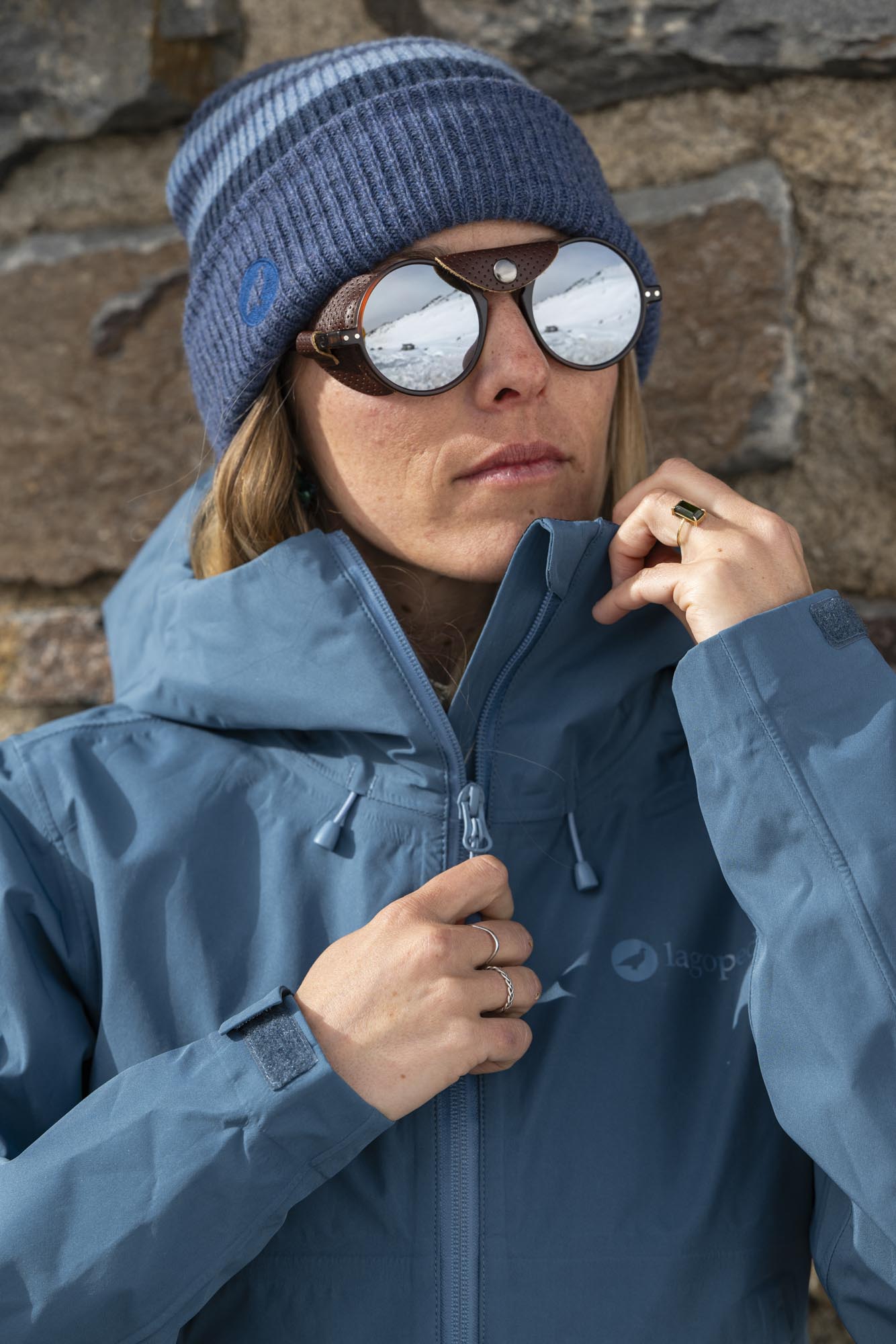
The EVE jacket for protection against the elements: 100 km/h winds on Etna, stormy rain in Sicily, cool mornings on the Valensole plateau. Sympatex membrane without PFAS, made in the European Union.
The HEYDO2 Hoodie, a lightweight hooded down jacket made with recycled wadding, perfect for bivouac evenings and early departures. Compressible, it fits into a saddlebag in the morning as soon as the sun rises.
To follow their adventure in Morocco: Gravel in Morocco with Charlotte and Nicolas.
Related product
Men's CARDUELIS BIB Cycling Bib Shorts
$170.00


