




What is waterproofing?
|
Cart
To go further:
|
Lagoped clothing is adventure gear that adapts to many activities: hiking, climbing, skiing, sailing, mountaineering, cycling, travel, etc. We are committed to offering technical and comfortable products to accompany you on all your adventures, whatever the weather conditions. That’s why we offer a wide range of waterproof clothing: from jackets to pants. Let’s review what waterproofness in a garment means.
Waterproofness is a material's ability to resist water penetration, keeping it dry. It is an important property in designing clothing or backpacks, and luckily, that’s our specialty!
The challenge for waterproof adventure clothing is also to be breathable (and for sports activities, one cannot go without the other). This allows the clothing to prevent rain or snow from penetrating while letting sweat escape, offering a perfect balance between waterproofness and breathability.
Julia Roger Veyer photographed the EVE jacket in Orange78 color.
In the fashion industry, there are natural waterproof materials like wax or rubber, often not very breathable and poorly suited for athletes' movements. These can be waterproof garments that are not breathable. More recently, synthetic materials are used to make waterproof and breathable membranes, which we will present in more detail.
The waterproofness level is called the Schmerber Level and corresponds to the fabric's water resistance level. It is measured in "water column," expressed in millimeters, representing the maximum water pressure the fabric can withstand before water passes through. Thus, the higher this number, the more waterproof and suitable the garment is for harsh weather conditions.
Several standards are used to measure waterproofness, the most well-known being standard 811-2018, which will be revised in the coming months. It structures water resistance tests using a water column and formulates waterproofness indices.
To help understand these indices: 1 Schmerber corresponds to one millimeter of water. Therefore, 1000 Schmerber corresponds to a one-meter column of water.
At Lagoped, we have chosen to offer waterproof clothing at the 20,000 Schmerber level, which is considered very high waterproofness, providing protection suitable for outdoor activities in heavy rain: hiking, skiing, mountaineering, etc.
Jodouin Mitrani photographs the EVE jacket in Soleil color and the SUPA pants in Royal Blue color.
These indices should be considered relative to factors such as movements that exert additional pressure on the fabric, as well as other garment-related factors: seams, closures, and special treatments that can influence overall performance. In the design of Lagoped clothing, we pay special attention to these elements, which we improve every year with our partners.
Other standards are used to measure breathability, such as the thermal evaporative resistance coefficient (RET) or the moisture vapor transmission rate (MVTR), but we will dedicate a future article to these to become experts on the subject.
The waterproofness of Lagoped clothing is ensured by the Sympatex membrane. This technology was developed in Germany by the company Sympatex Technologies GmbH, founded in 1986.
Unlike other waterproof membranes on the market, it is called "solid" because it does not have "holes," which are the pores. This is a significant advantage when looking for a durable membrane: pores tend to clog over time, which is not the case with the Sympatex membrane, whose functions are maintained over time.
It is based on a physico-chemical principle, which we will explain right away. You can imagine a membrane made of two fabrics: an outer fabric that is hydrophobic, it dislikes water and prevents it from penetrating, and an inner fabric that is hydrophilic, it likes water and absorbs the water vapor generated by body heat and expels it outside. These absorption and evaporation processes allow moisture transfer through the membrane and ensure its breathability. The greater the differences in temperature and humidity, the more significant and effective the breathable effect of the Sympatex membrane will be. It thus perfectly adapts to different sports activities and weather conditions.
In addition to being breathable, the Sympatex membrane is also windproof, ensuring that the layer of warm air does not move away from the body, according to the DIN EN ISO 9237 standard which determines the air permeability of fabrics.
At Lagoped, transparency with our customers is essential, which is why we take the time to explain every function of our garments and the steps of their manufacturing. Our waterproof garments using the Sympatex membrane comply with standard 811-2018, which governs the measurement of fabric waterproofness in the industry and according to which a fabric is waterproof starting at 1500mm. Sympatex must therefore regularly conduct water resistance tests using a water column.
In addition to these initial tests, there are so-called shower tests. As the name suggests, this involves placing the finished garment in a shower and applying strong pressure on all parts of the fabric. This test allows us to verify the waterproofness of the entire garment and the effectiveness of the seams, zippers, and the more accessible and sensitive parts of the garment. This is a test we like to perform during the design of our garments, as it guarantees their performance in terms of waterproofness.
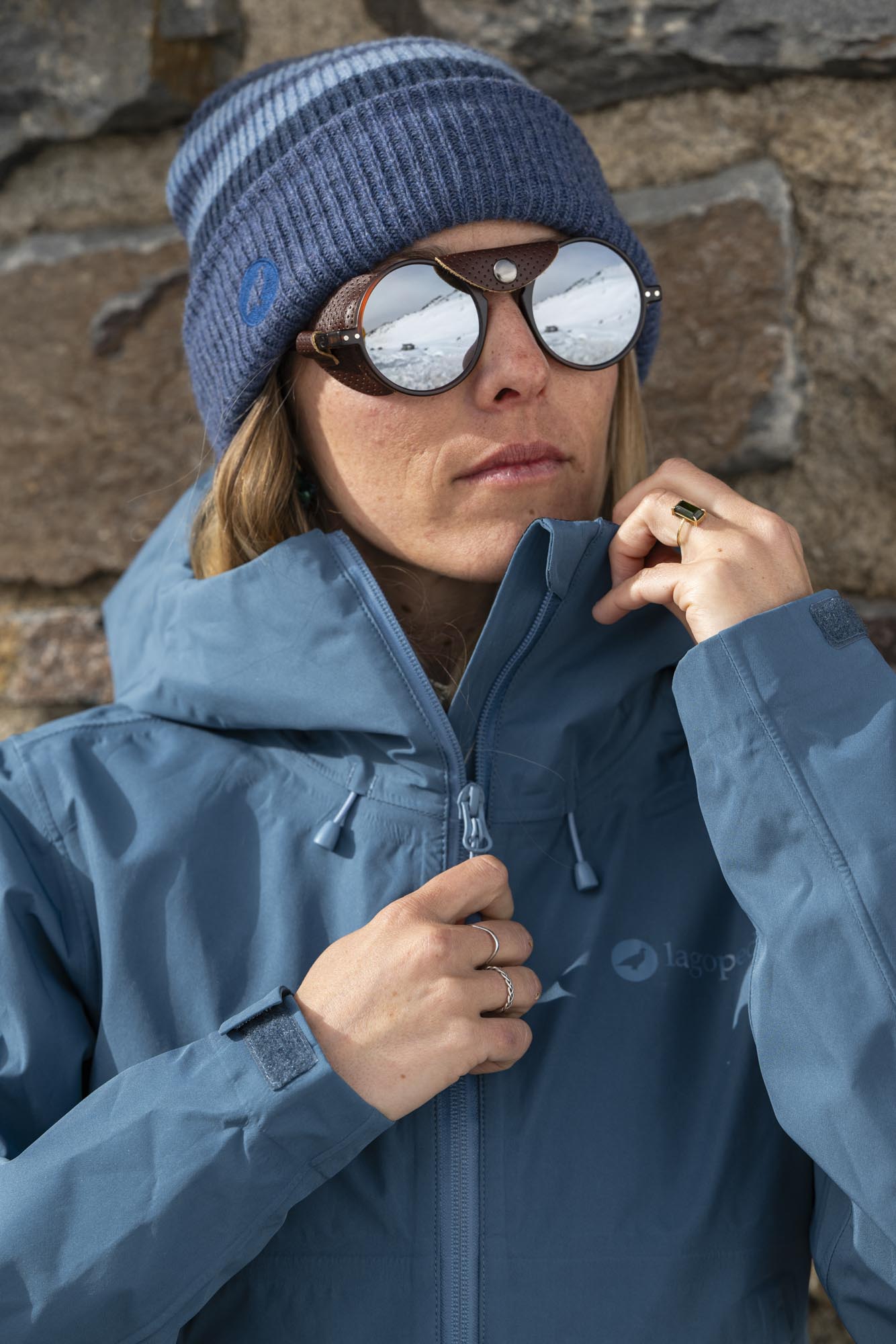
Let's take a closer look at the construction of the EVE jacket, waterproof and versatile to accompany you in your many sports activities and in all weather conditions. Looking inside your jacket, you will see that every seam is sealed with heat-bonded tape. Indeed, the garment's construction is very important to ensure its waterproofness. These waterproof tapes are developed with our partner Sympatex and our factories.
Discover or rediscover the technical features of the EVE jacket Men’s and Women’s.
Franck Bernes Heuga photographs Arthur Bertrand in the EVE jacket and SUPA pants in colors that are no longer available.
As you might expect, the test we prefer above all is the field test. Members of the Lagoped teams, Christophe its founder, first of all, as well as some ambassadors of the Lagoped Family, are invited to test new products by practicing their favorite activities and exploring the highest peaks and most beautiful valleys. They provide us with all the necessary feedback to offer you products worthy of being worn by the greatest adventurers who love Nature—you.
To care for your waterproof and water-repellent clothing, we recommend not washing your membrane products too often. Indeed, the less they are washed, the better they perform. This is due to the water-repellent coating applied to the garments, which gradually disappears with washing and is one of the main reasons for the loss of effectiveness.
The most well-known membrane is undoubtedly the Gore-Tex membrane. We have already covered the differences between the Sympatex membrane and the Gore-Tex membrane in a previous article.
But did you know that there are other breathable and waterproof membranes? There is something for every taste and budget. You have probably heard of the Hydro membranes from the brand Craft, Polartec's NeoShell, or The North Face's HyVent. Some companies create waterproof and breathable membranes that are more environmentally friendly, and that’s great news. This is the case with the Dimpora membrane developed by a Swiss startup; it is a waterproof and breathable membrane with a microporous structure. It is made of polyurethane, without PFCs. Similarly, the LIFA Infinity Pro™ membrane is developed by the brand Helly Hansen, which aims to reduce its environmental impact with chemical-free manufacturing.
Seeing the outdoor textile industry strive to improve by offering more sustainable technologies can only make us smile.


