




Women in the Mountains with Menez Roz: All Together at the Top
|
|
Marie-Anne is 66. She has never played sports. She doesn't know the mountains. When she is offered the chance to join Menez Roz, she says yes without really realizing what it entails. "I thought to myself: you've never done anything for yourself, come on, go for it." She will repeat this phrase a thousand times in the months that follow, during the preparation sessions in Finistère, during the climb to the Albert 1er refuge, which will be the most difficult moment of her life, and upon arrival, in tears, when she realizes she has done it.
Menez Roz is the story of women like Marie-Anne. Nine per group, from Brittany, all affected by breast cancer, and all discovering that their bodies, after treatment, are capable of much more than they thought.
Isa Magois learns that she has breast cancer in May 2023. During her recovery, she sets herself goals in the mountains.
She quickly understands what it does: not only to her muscles, but also to her mind, her relationship with her body, and her ability to imagine what comes next. In October 2024, she founded the association with three friends. Menez Roz, the pink mountain in Breton. A summit for all.
The idea is not to pursue athletic performance. It is to use the mountains as a tool for physical and psychological recovery, in connection with the medical teams. Participants come through the Kemper Breast Institute, their physiotherapists, their adapted physical activity coaches, or now directly through the association's networks.
Some had never put on a pair of hiking boots in their lives, but many of them are about to embark on the greatest adventure of their lives.
"Diagnosed with breast cancer in April 2023, the mountains were a real accelerator in my recovery, both physically and mentally. I wanted to share the benefits of this environment."
Preparation begins in the fall, with hikes that help participants get to know one another. From the beginning of the year, it is structured around four pillars.
Basic endurance, "the engine": brisk walking, running, cycling, and swimming, at around 70% of maximum heart rate, to sustain several hours of exertion without collapsing.
Muscle strengthening, "the chassis": squats, walking lunges, core exercises, because glacier travel places enormous strain on the knees, ankles, and back, while a 10 kg pack shifts the center of gravity in a way the body is not accustomed to.
Specific terrain training, with loaded stair climbs to simulate elevation gain, which is impossible to recreate in Finistère.
Acclimatization and hydration are also often overlooked: learning to drink while exerting yourself and arriving well rested.

The objective for the summer 2026 trips is precise: to take this group of women safely into the mountains: to be able to walk for more than four hours carrying a 10 kg pack, complete 500 meters of positive elevation gain, and sustain at least four consecutive days of exertion.
Justine, an adapted physical activity coach, supports each participant and adapts the program to the after-effects of treatment : residual fatigue, lymphedema, reduced mobility, and chronic pain. "It is difficult, if not impossible, to recreate mountain conditions while preparing in Finistère. The fatigue is more intense, some of the women experienced headaches and significant shortness of breath. That is also why the guides are present on the trips."
Camille, 49, is a perfect example of what this preparation changes in practical terms. Diagnosed in 2020 and completing her treatment journey in November 2025, she was not naturally athletic and began walking on medical advice. What began as an obligation became a need. Her physiotherapist introduced her to Menez Roz. The first trip to Chamonix introduced her to activities she had never tried before: climbing, via ferrata, and glacier walking. Above all, she met women who had gone through exactly the same journey as she had, whereas she had gone through her illness largely alone.
"The preparation and the first trip allowed me to regain confidence in my body and my abilities. Finally turning the page on that period of my life, roped together with exceptional women."
2026 marks a step up for the association. Three trips to take women into the mountains, three levels of difficulty, one shared direction: upward.
In March, Vallouise. First winter trip: snowshoeing, cross-country skiing, hiking, and biathlon. One week to discover the mountains in winter, kick off the season, and begin preparing their bodies for what awaits them in summer.
In June and July, two groups of nine women meet in Chamonix, with Albert 1er Refuge as their base camp.
The first trip (June 28–July 4) focuses on acclimatization: high-altitude hiking, rock climbing, and glacier walking.
The second trip (July 5–11) builds on the same progression, beginning with a major hike, a longer route on the Glacier du Tour, and a paragliding session to close out the week.
Guides Sophie Moritz and Emilie Fourot led the roped teams on the first trip; Marie Raphael (AMM), Suzan Loret, and Anna Torreta led those on the second.
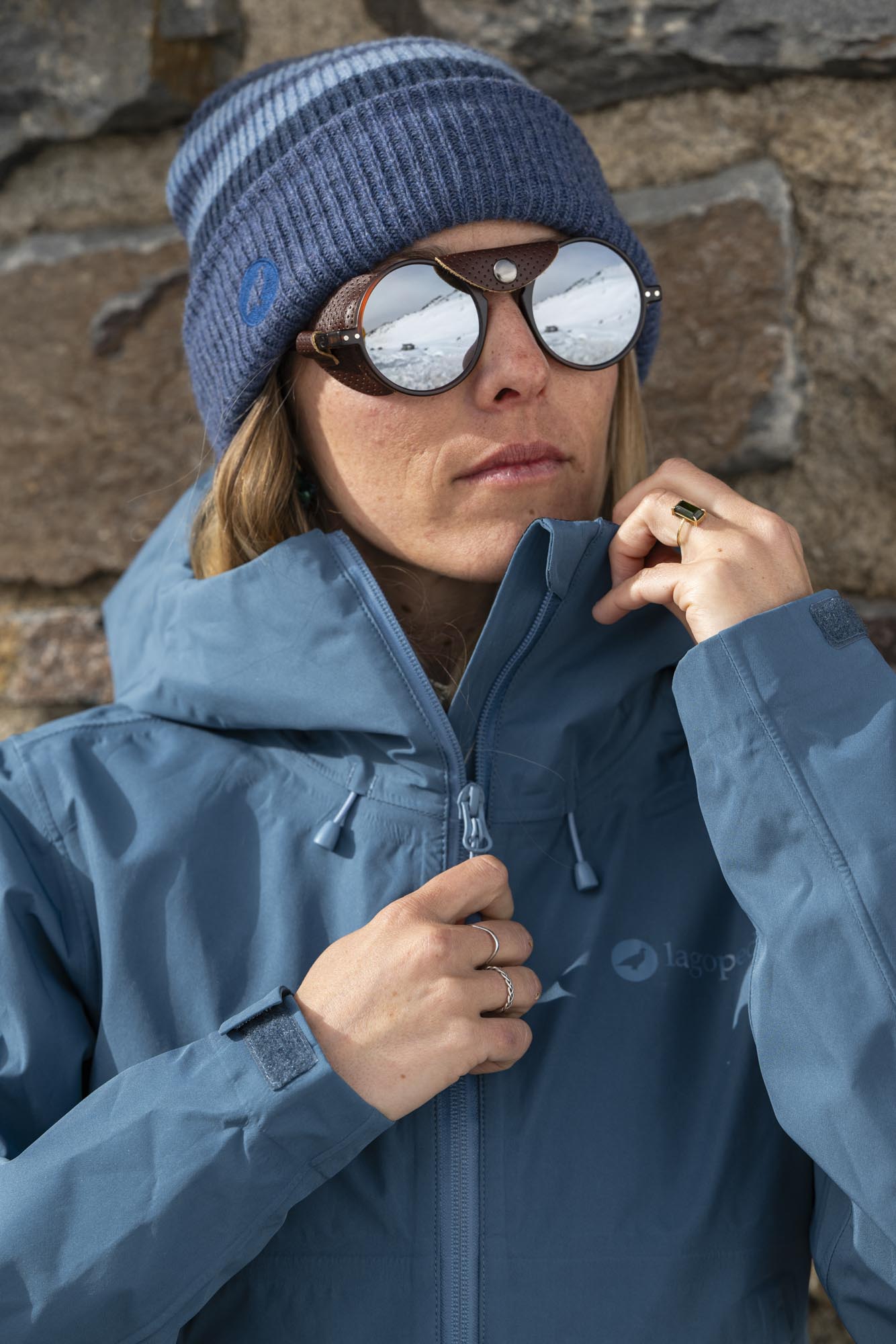
The Lagoped technical jackets accompanied the participants on all three trips: in Vallouise during the winter trip, and during the two summer weeks of glacier hikes. When you set out on the glacier at 5 a.m. and the cold bites, being cold is not an option.
"When you set out on a glacier hike at 5 a.m., with the cold biting, you realize how important it is to have great gear. On the glacier, it was really great to have them."
Stéphanie was part of one of those roped teams. Six months of preparation, then Chamonix. She had told herself it would be difficult. It was more so than she had imagined. "I had to dig deep within myself to make it to the end. Despite the difficulty, what I remember most is the bond forged through the mutual support and encouragement of my climbing partners. I came home deeply changed by what I experienced there."
And then there is Marie V. She went to Chamonix after her doctor had just told her she had metastases. The medical team met to decide whether she could go. Since there was no risk of fracture, they said yes.
"Leaving nourished me, like an enchanted interlude. I told myself: take the best from it, do what you can. Make the most of it—you don’t know what you’re going to have to face, so take everything you can. And the whole team carried me through. I managed not to falter."
What makes Menez Roz different from a simple hiking association is the three-tier support system surrounding each of these women in the mountains.
The high-mountain guide is the expedition leader: safety, weather, technical route selection, and rope management.
The sport and health supervisors—physiotherapists, nurses, or adapted physical activity coaches—organize warm-up and recovery sessions every morning and evening during the trip, advise on posture, manage minor aches and pains, and make sure no one ends up completely exhausted.
And Isa, who knows every participant, what she has been through, what she carries.

Marie H, a nurse who has worked in oncology surgery for 26 years and a care coordinator at the Kemper Breast Institute, supported these women from the announcement of their diagnosis through the end of their treatment.
When the opportunity to be a supervisor on the trip came up, it was an obvious choice. "Supporting these women through such a powerful challenge, beyond the mountains, meant helping them regain confidence in their bodies, their abilities, and themselves. Being together gave us real strength. The true summit was the one each woman reached by regaining confidence in herself, carried by the group."
Justine, an adapted physical activity coach, watched the group transform week after week between the sessions in Finistère and their arrival at the Albert 1er refuge.
"It’s something I’ll never forget. Expanding your comfort zone in an area you knew nothing about, learning things about yourself physically. Preparing for six months and ending up like this—it’s amazing."
Marie-Anne came back from the trip different. Not healed differently, but changed in how she related to herself.
"It is the culmination of my life. It is a memory that will never fade. The mountains enabled me to push myself in every way. The magical moment was discovering the landscape, the serenity, walking on the glacier, surrounded by empathy and sisterhood, everything needed to rebuild oneself and look upward to keep moving forward forever."
What all these women describe has something in common: the mountains gave them back something that treatment had damaged. Not their health in the medical sense. Their relationship with their own bodies, their confidence in their ability to do difficult things, their feeling of belonging to something greater than themselves.

Isa puts it simply: what strikes her most each time these women return from a mountain trip is not their athletic performance. It is the psychological change.
"They realize that they are capable of much more than they think. Almost all of them want to introduce their families to the mountains. Some have already done so."
The association was invited to the Women in the Mountains Festival to present its project. The film about the winter trip, "The Girls of Vallouise," directed by Coline Beal, was submitted for selection. Two films about the summer 2026 trips, directed by Gilles Dedeurwaerder, are currently being edited.
Organizing a trip costs approximately 22,000 euros for two groups of nine women, including transport, accommodation, sports supervision, guides, and equipment. Menez Roz is supported by the solidarity events of Octobre Rose: Kemper'ose, Concarn'rose, Trégunc Rose, as well as by the Kemper Institut du Sein and several partners including Lagoped, SVR Lazartigue, and Guy Cotten. Recognized as being of general interest, the association enables its supporters to benefit from tax advantages.
To support or join the adventure: menezroz29s@gmail.com or via HelloAsso.
Lagoped supports the Menez Roz climbing team with equipment designed so that nothing in their gear becomes an obstacle on the way to the summit.


