



Reduce our impact on the environment
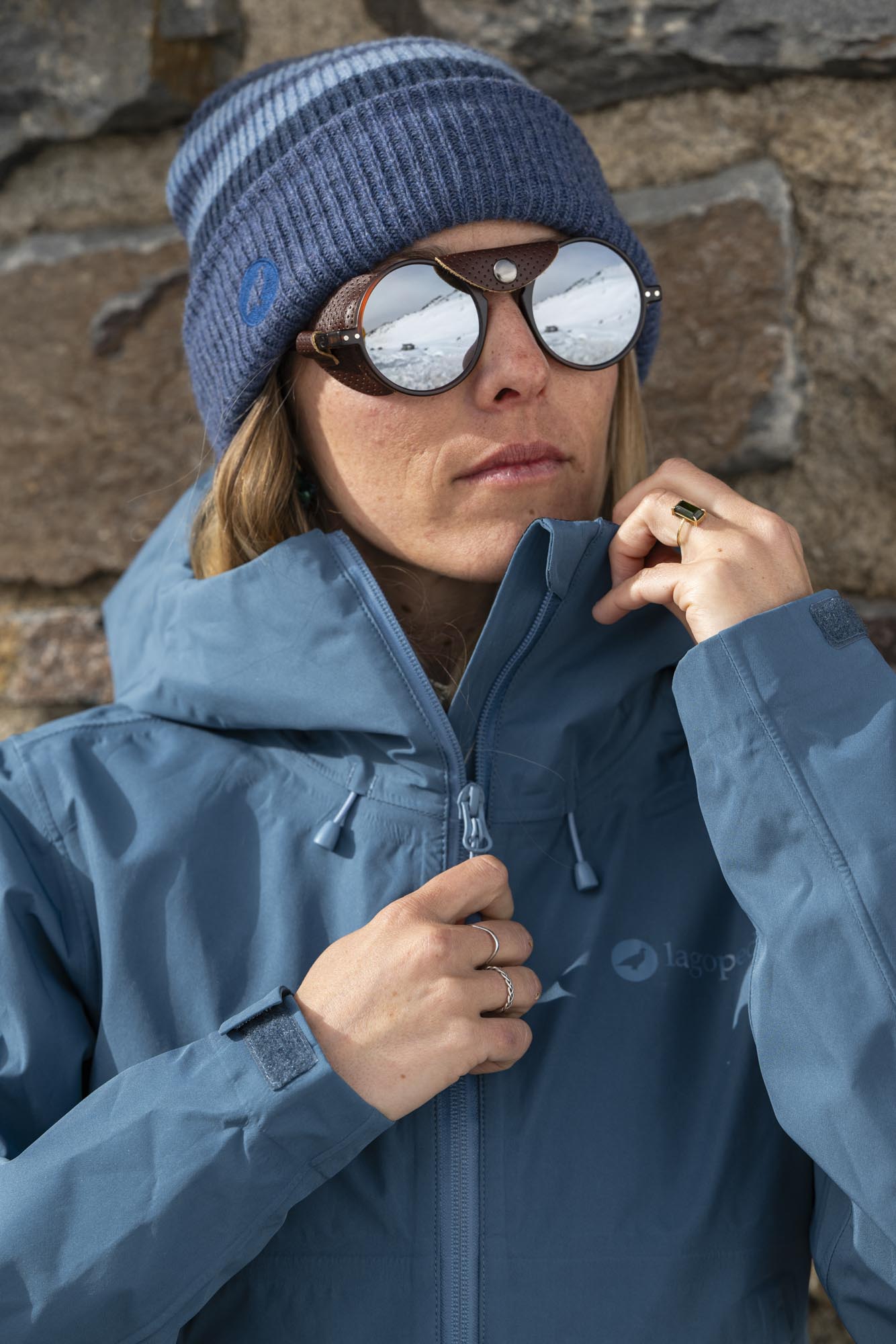
To help us make daily choices about the materials for our clothing, we return to Lagoped’s original idea: the bird’s simplicity. And this simplicity translates into reducing our pressure on Nature. Specifically, to achieve this, we have decided to prioritize recycled materials over materials obtained through extraction. This means rejecting virgin natural materials (from agriculture or livestock farming) and virgin synthetic materials (from the petroleum industry) in favor of recycling waste: more than 80% of the weight of our clothing is now made from recycled materials (82.8% for the 2025-26 financial year). Only a few exceptions remain, such as elastane.
This is a strong, structuring choice that allows us to preserve water and arable land, avoid deforestation, and limit greenhouse gas emissions. We explain how we measure our impacts using the European eco-score’s PEF method.
To reduce our “invisible” impact, we use water-repellent products and membranes that do not contain fluorinated compounds (the “PFAS”), which are classified as endocrine disruptors. This is a topical issue, highlighted by a recent film that tells the story of the trial in the United States of a company accused of poisoning a community with these products (Dark Waters with Mark Ruffalo and Anne Hathaway, 2019).
For our technical clothing, we have chosen the Sympatex membrane, which contains no fluorinated compounds, unlike other membranes, and offers excellent mechanical properties (windproofing, waterproofing, and ventilation). What’s more, it is recycled, recyclable, and manufactured in Europe.
Recycling makes it possible to absorb the stock of materials already in circulation and significantly reduce impacts. For example, 1KG of recycled cotton can be used to make 6 T-shirts that will avoid (source: AITEX, Universitat de Valencia, and UNESCO):
- cultivating 10m2 of arable land,
- using 15'000 liters of water (120 five-minute showers)
- emitting 23kg of greenhouse gas emissions (approximately 200KM in a small gasoline car that
consumes 6.5L/100KM and emits 125g)
Recycled wool, for its part, makes it possible to reduce environmental impacts by 98% compared with traditional wool (source: Systèmes Durables and EVEA conseil).
Finally, we are committed to addressing the end of life of our clothing. With our supplier Sympatex®, we are beginning an initiative aimed at making new yarn from our technical clothing (Wear2Wear program). Circularity is becoming a reality and is no longer quite such a distant dream.
You become participants in a circular economy and, together, we use resources that are already available and reduce our impact on nature.