




AMPeak at the Refuge des Cosmiques: Engineering at the Service of Waste Management at High Altitude
|
Cart
To go further:
|
Some engineering projects end up in a report. Others end up attached to a rock face, carried on foot along the arête à Laurence to the Refuge des Cosmiques. Timothée, Tristan, Tilio, and Louis belong to the second category.
AMPeak was born from a simple conviction: engineering can serve the mountains. Timothée Pierrel and Tristan Le Metayer, in their second year at Arts et Métiers in Châlons-en-Champagne, and Tilio Kreel and Louis Valentin, in their third year, came together around an association project that combines their training with their passion for the high mountains.
The starting point was to call the Refuge des Cosmiques and ask what could concretely help them. Not a list of ideal wishes, but a genuine conversation about what causes problems in their daily lives. The answer came quickly: waste management at high altitude.
In the high mountains, waste does not come down on its own. Depending on the hut, mountaineers carry it down in their packs, the guardians carry it on foot, or a helicopter makes the trip. In every case, the constraint is not so much the weight as the volume. An empty can or plastic bottle takes up as much space as a full one. Multiplied over an entire season of visitors, that amounts to a substantial number of bags.
AMPeak's idea for optimizing waste management at high altitude: cut this volume by 2 to 6 using mechanical crushers adapted to high-mountain conditions. Instead of 5 or 6 bulky trash bags, there are 1 or 2. It is not spectacular on paper. At a mountain hut, it is exactly the kind of detail that changes the guardians' daily lives.
"At a mountain hut, what works is the sum of small practical details."
The constraints of high altitude dictated every manufacturing decision. No electricity, no pneumatics, no hydraulics: everything had to work purely mechanically. And all this equipment for optimizing waste management at high altitude had to be carried on foot up to 3,613 meters.

The can crusher builds on existing models, with a sheet-metal slide, but was completely redesigned for durability. The sheet metal thickness increases from 1.5 to 3 mm. A second handle is added beneath the first to prevent the system from twisting if the user does not press perfectly vertically: when you are tired after a night at altitude, the movement is not always precise. Foot-operated variants that crush the can were ruled out from the outset: in a mountain refuge, space is limited and debris flying across the floor poses a real risk.
The bottle crusher called for a different approach. An entirely metal structure would have been too heavy to transport. The solution: 3D-printed parts with 70% infill for the weight-to-strength ratio, and connecting rods cut from 6 mm steel by electrical discharge machining, an extremely precise process that made it possible to work with salvaged materials. If a part breaks during the season, the wardens can replace it without outside assistance.
The purely technical part took a few weeks. Everything surrounding it took 18 months.
Setting up the association, handling the administrative work, finding funding, launching crowdfunding campaigns, contacting suppliers, and fitting it all in around classes and exams.
"Unlike other student projects carried over from year to year, we were starting from scratch."
The school's machines were not always available.
The punch press required entering code lines by hand: every time the dimensions were modified, everything had to be redone from the beginning. The press brake did not deform the metal exactly as predicted by the CAD software, requiring continuous adjustment of the patterns to achieve the correct final dimensions. And managing the clearances—tight enough for proper guidance, but not so tight as to cause jamming—remained a headache right to the end.
The team divided up naturally: Timothée and Tristan on site for manufacturing, Tilio and Louis from their third-year campus for CAD, sizing, and discussions with partners.

Installing the machines for better waste management at altitude at the Refuge des Cosmiques was more than a delivery. First, we had to get there with the machines, via the Arête à Laurence. A technical ascent, roped up with guides, at an altitude of over 3,500 meters.
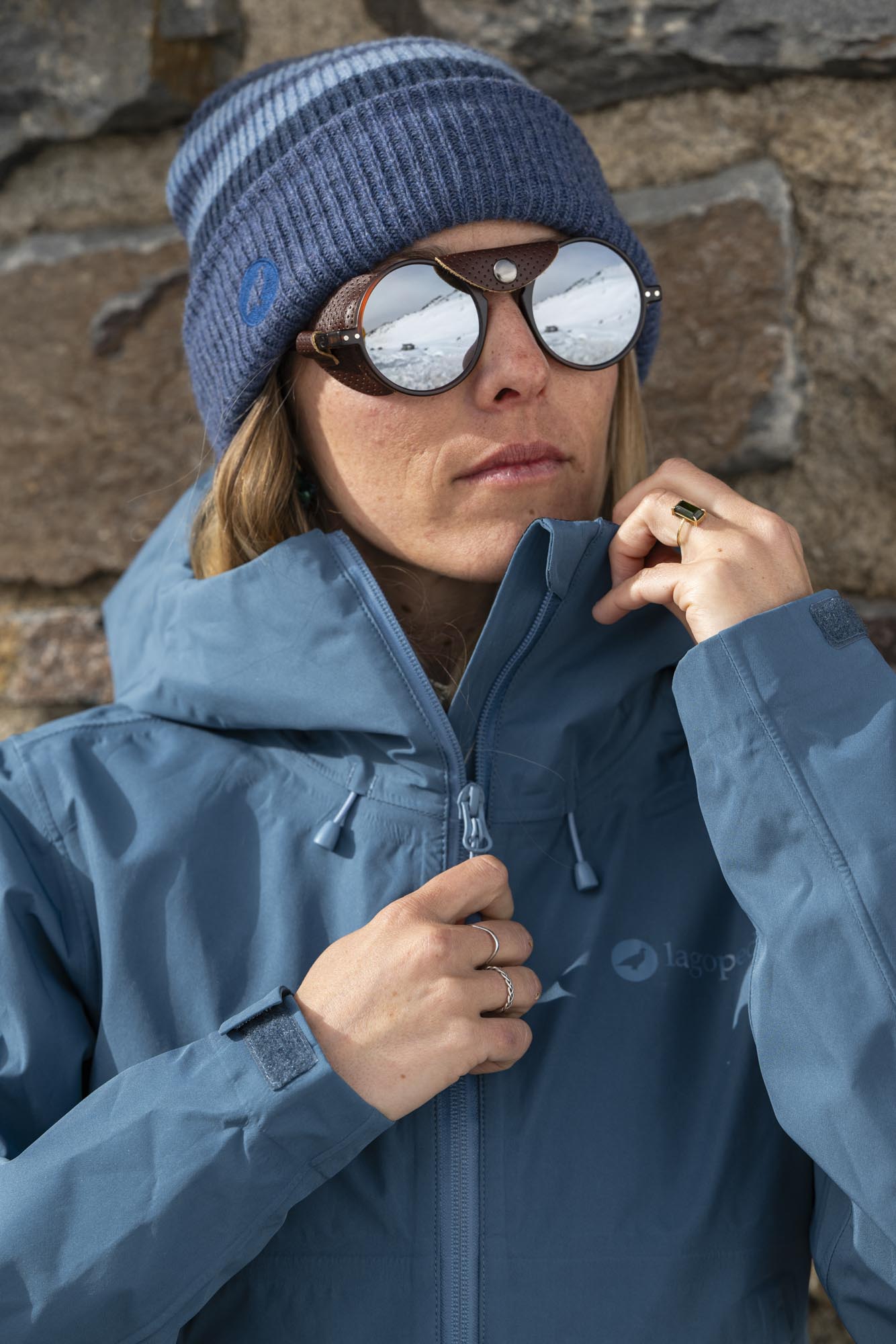
At this altitude, the light is unforgiving. UV radiation increases by around 4% every 300 meters, and the reflection from the snow and glaciers of the Mont Blanc massif leaves no room for improvisation. The four students wore the LAGOPEYE CAT4 sunglasses continuously throughout the expedition: during the approach hike, on the technical roped ascent, and on the hut's outdoor terrace.
LAGOPEYE CAT4 glasses are made and assembled in France, with a frame made from recycled plastic sourced from industrial offcuts and lenses made from upcycled polycarbonate. The removable sun shield, a distinctive feature of the model, is particularly suited to high-mountain conditions, where glare comes as much from below and above as from the sides.
What this concretely changes in waste management at altitude
The installation did not reduce the number of helicopter rotations: at the Refuge des Cosmiques, these rotations are already optimized—the aircraft brings up supplies and leaves fully loaded, often servicing several huts on the same trip.
But if the problem is volume rather than weight, compacting waste reduces the size of the packs and limits their swinging beneath the aircraft. And for hut wardens, going from five bulky bags to two changes the day-to-day management of waste at altitude, week after week.
The warden of the Grands Mulets hut, who asks mountaineers to bring their own waste back down, showed interest in the project. Waste management at altitude remains an open challenge for many huts. AMPeak is not done climbing yet.


