



The Svalbard Rock Ptarmigan
|
|
When we think of Svalbard, we think of the polar bear, reindeer, Arctic fox, and Arctic tern. It is indeed the polar bear that we have chosen for our project because its survival is systemic to the loss of ice in Svalbard and the global change of the cryosphere.
But there is also another symbol of the Arctic, a more discreet animal, a relic of the last great ice age, the rock ptarmigan (Lagopus mutus hyperborea / Svalbardrype in Norwegian).
The Svalbard archipelago hosts one of the largest concentrations of birds in the North Atlantic, not in terms of species number since only 164 species are recorded, but rather by the number of birds, with some colonies of guillemots exceeding 150,000 pairs.
The rock ptarmigan is quite different because it does not live in colonies and is the only one to reside year-round on the archipelago, making it a true inhabitant of Svalbard’s wild nature, as well as a master of survival and adaptation to the climate at these latitudes.
That is why it can be said to be a totemic animal of Svalbard, its presence symbolizing the retreat of glaciers since it now nests where ice used to be.
The Svalbard rock ptarmigan is a medium-sized bird, a subspecies of the rock ptarmigan, endemic to Svalbard, both heavier and larger than its mainland relatives.
Measuring about 35 centimeters in length and weighing between 490 and 1,200 grams depending on the time of year, it accumulates fat in summer to survive the long winter months.
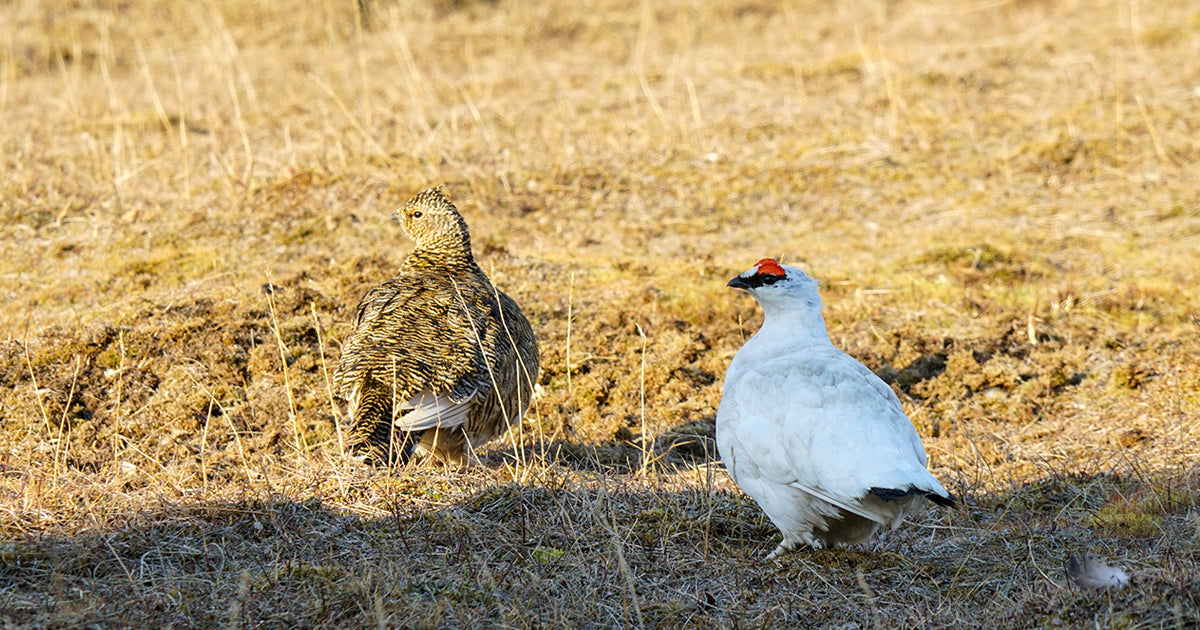
In winter, the plumage of males and females is completely white, with their red crest above their eyes the only touch of color.
In April-May, females wear their summer plumage with a reddish-brown color. Males keep their white plumage until July, a perfect example illustrated by the photo.
It is only in mid-August that the males also put on their summer attire, which features brown plumage, so that by the end of September, males and females regain their white winter plumage.
So, one must be patient and persistent to observe this virtuoso of camouflage, white in winter and rock-colored in summer.
It is by observing animals like the ptarmigan that we realize how fantastic our planet is. Facing glaciers, icebergs, and wildlife and flora that have adapted to such an intense environment, everything makes sense, and we are captivated.
We believe that the outdoors can change lives.
It is high time to reconnect with Nature and relearn to love it because wonder in the face of nature is the key to the changes we need.
Learning differently by immersing yourself in a place like Svalbard, where Nature is omnipresent and magnificent, is the best way to better understand our Planet, reconnect with the Nature we are part of, love it again to better preserve it, and simply take action.
This is what we try to do with our explore.Svalbard project by connecting young explorers to nature so they can feel its strength, fragility, and freedom.
Learning to explore differently means understanding how to preserve and act at the same time.
Photos: Explore Svalbard // Olivier Nolin – The wildlife is fantastic, let's stay discreet and remember that we are guests.


