



It's not just CO2 in life
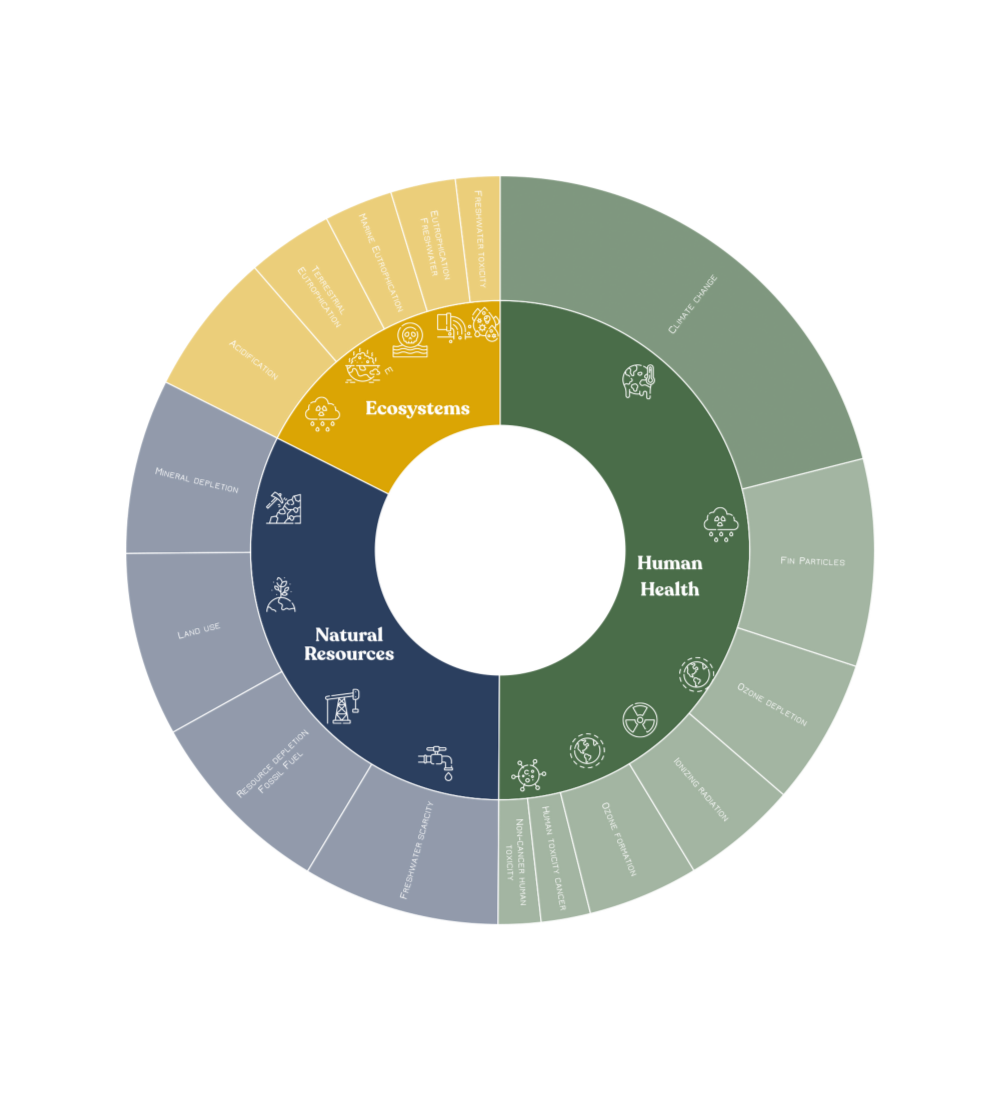
The impact measured goes well beyond just global warming, which is a major issue but not the one and only one. Talking only about global warming amounts to hiding all the other issues. This method of measuring impacts makes it possible to cover numerous impacts.
At Lagoped, we have since the beginning worked on other subjects and we are delighted that they are taken into account in the PEF method.
Our choice for recycled materials (organic-free) was precisely guided by the desire to move away from the logic of extraction to preserve:
- water resources
- arable land
- the biodiversity
The Earth has between 8 and 20 million living species. Only one dominates them all, that’s us. However, humans only weigh 0.01% of the Earth's biomass. (The biomass distribution on Earth. Proceedings of the National Academy of Sciences - Yinon M. Bar-On, Rob Phillips, and Ron Milo)
And we translated it in our brand message as “One with Nature” because we are part of a whole and we are not above the fray. Measuring the global impacts of our activities goes hand in hand with the growing awareness that we save ourselves by protecting Nature.
A methodology and a database
In order to carry out the calculations PEFTrust uses the only method recognized and recommended by the European Commission.
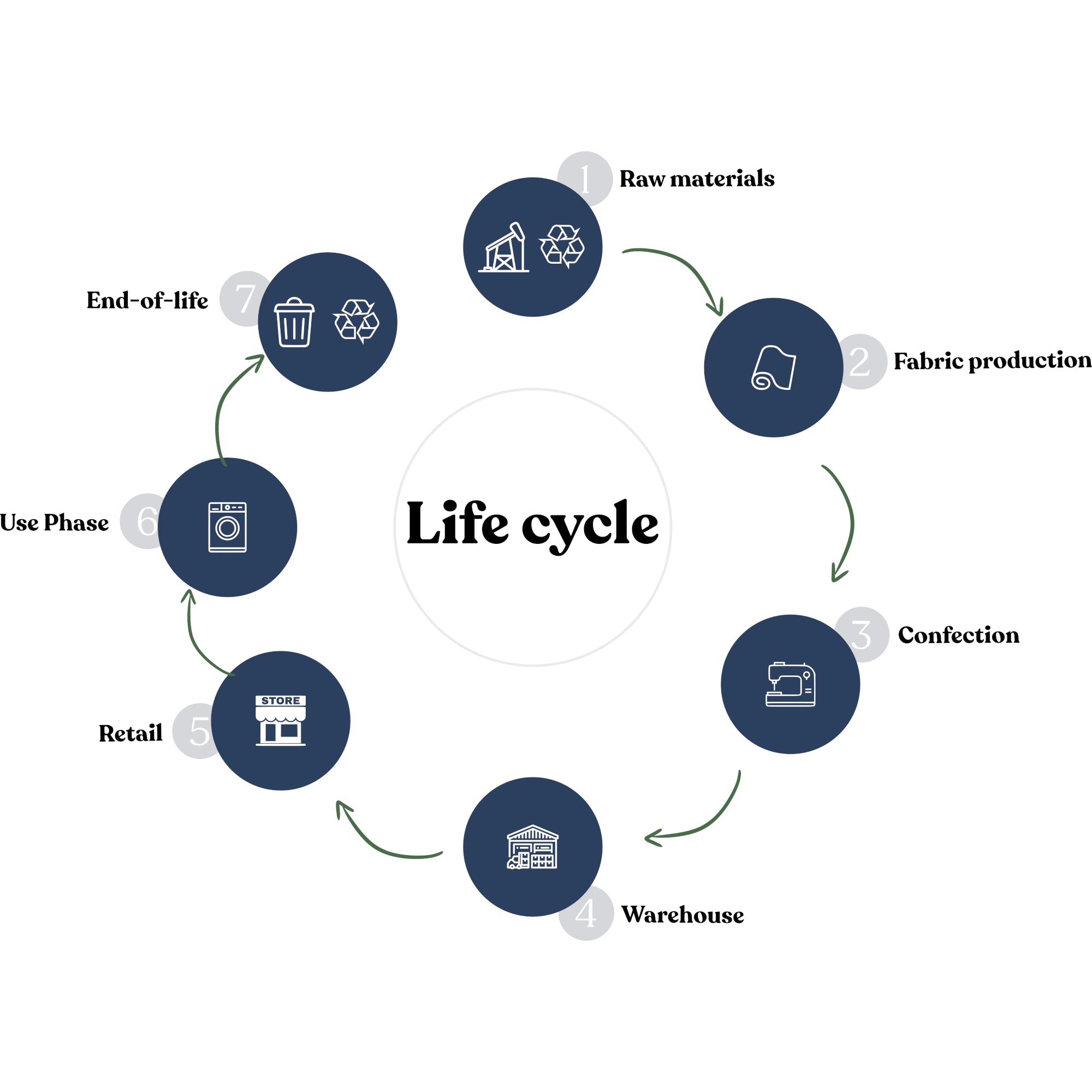
The 16 impacts are evaluated through the 7 stages of the clothing life cycle.
To put it simply, there are 2 elements:
* AN ADVANCED METHODOLOGY
The PEF is a scientific and serious method on which more than 3,000 European actors have worked since 2013. Scientists, NGOs and industrialists have joined forces to create a cutting-edge method recognized throughout the world.
The Product Environmental Footprint Category Rules was established by a working group with ADEME and under the aegis of the European Commission which we invite you to read in detail if you want to see for yourself the richness and depth of the study.
* AN EXTENSIVE DATABASE
All life cycle calculations are based on free resources made available by the European Commission which may evolve over time. Good news, eco-scores will evolve at the same time as knowledge on impacts.
Soil depletion
We live on 30CM of arable (cultivable) land, or 0.00024% of the Earth's diameter.
Every second, nearly 1 hectare of arable land disappears around the world.
That is 30 million hectares of arable land lost each year, the equivalent of the area of Italy.
It takes between 200 and 1000 years to naturally replenish 2.5 cm of soil. It is not a renewable resource on a human scale.
As a brand we do not want to add pressure on arable land which must be preserved and reserved as a priority for human food.
This is why we do not use virgin cotton or wood pulp because you need land to grow them.
Fresh water shortage
When you look at planet Earth from space, the blue planet looks like there is a lot of water.
But this is not really the case when you look closer and American scientists Howard Perlman, Jack Cook and Adam Nieman have illustrated this well by putting all the water on Earth in a single sphere.
Only 2.5% of all water on the planet is fresh drinking water. And only 1% is easily accessible to us.
It is a precious resource and as a brand we do not want to add pressure on water resources which must be preserved and reserved as a priority for human food which consumes a lot of water : for example, 900L of water is required. water for 1Kg of potatoes.
That's why we don't use cotton or wood pulp because it takes a lot of water to grow them.
Collapse of biodiversity
We can see for ourselves that there is less wildlife around us.
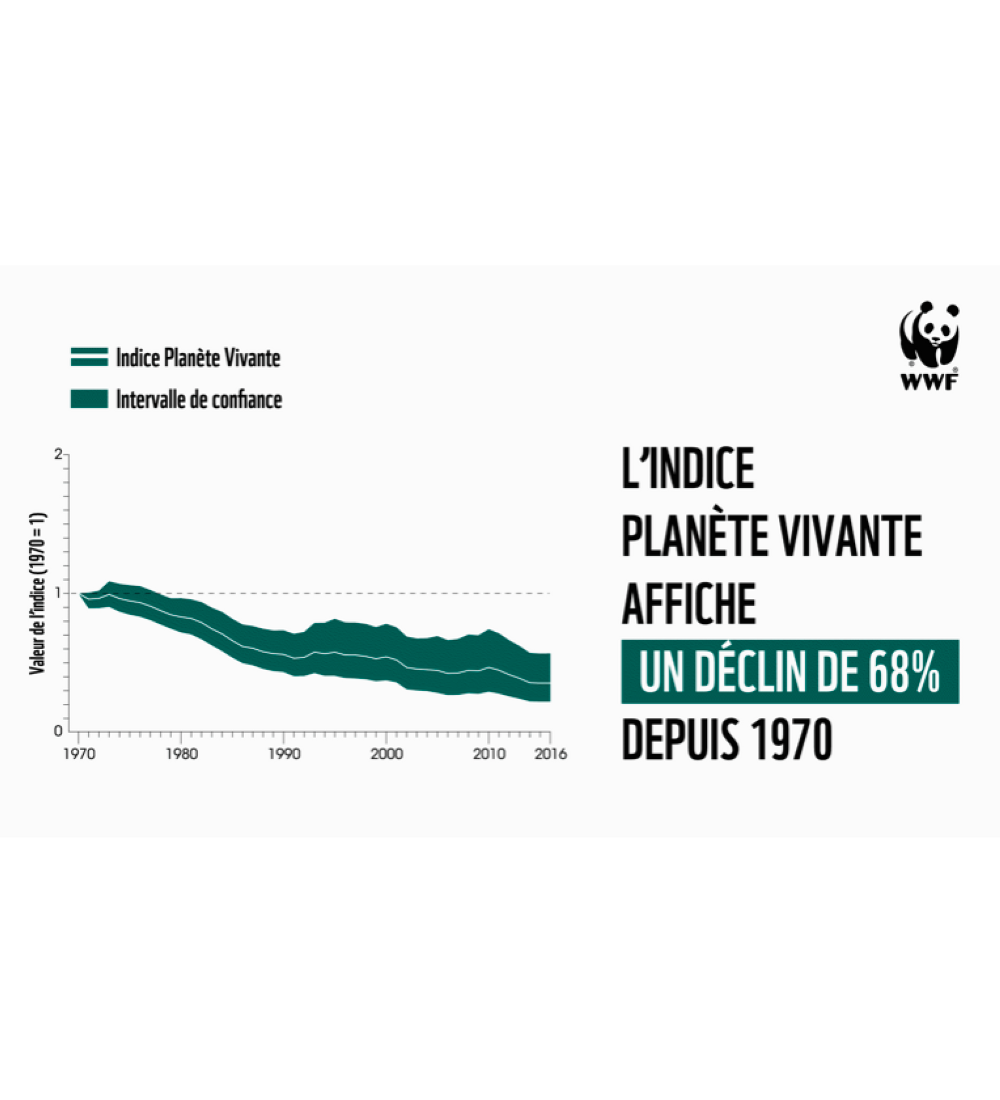
In thirty years, the populations of birds in agricultural environments and those of birds living in urban areas have decreased by almost 30% ( National Museum of Natural History, French Office for Biodiversity, League for the Protection of Birds ). The WWF Living Planet Index measures a 68% decline in all wild vertebrates since 1970.
A 2017 German study measured an 80% drop in insects in Germany since 1989. However, insects are the “fuel of life” and you have to read David Goulson's book to be convinced of this (Silent Earth. Prevent the extinction of insects, editions of Rouergue).
An interesting perspective consists of converting the geological history of the Earth on a 24-hour scale. Knowing that the Earth was formed 4.567 billion years ago, this is a number too large to comprehend. Transposed onto a 24-hour scale, it is therefore midnight today and the Earth begins at 0:00 a.m. In this case:
- dinosaurs appear at 11:00 p.m.
- the first mammals at 11:25 p.m.
- and the first steps of Hominids take place at 11:59:30 p.m.
On the scale of the Earth, we have only been here for 30 short seconds.
So how many more seconds do we want to stay in good conditions?