



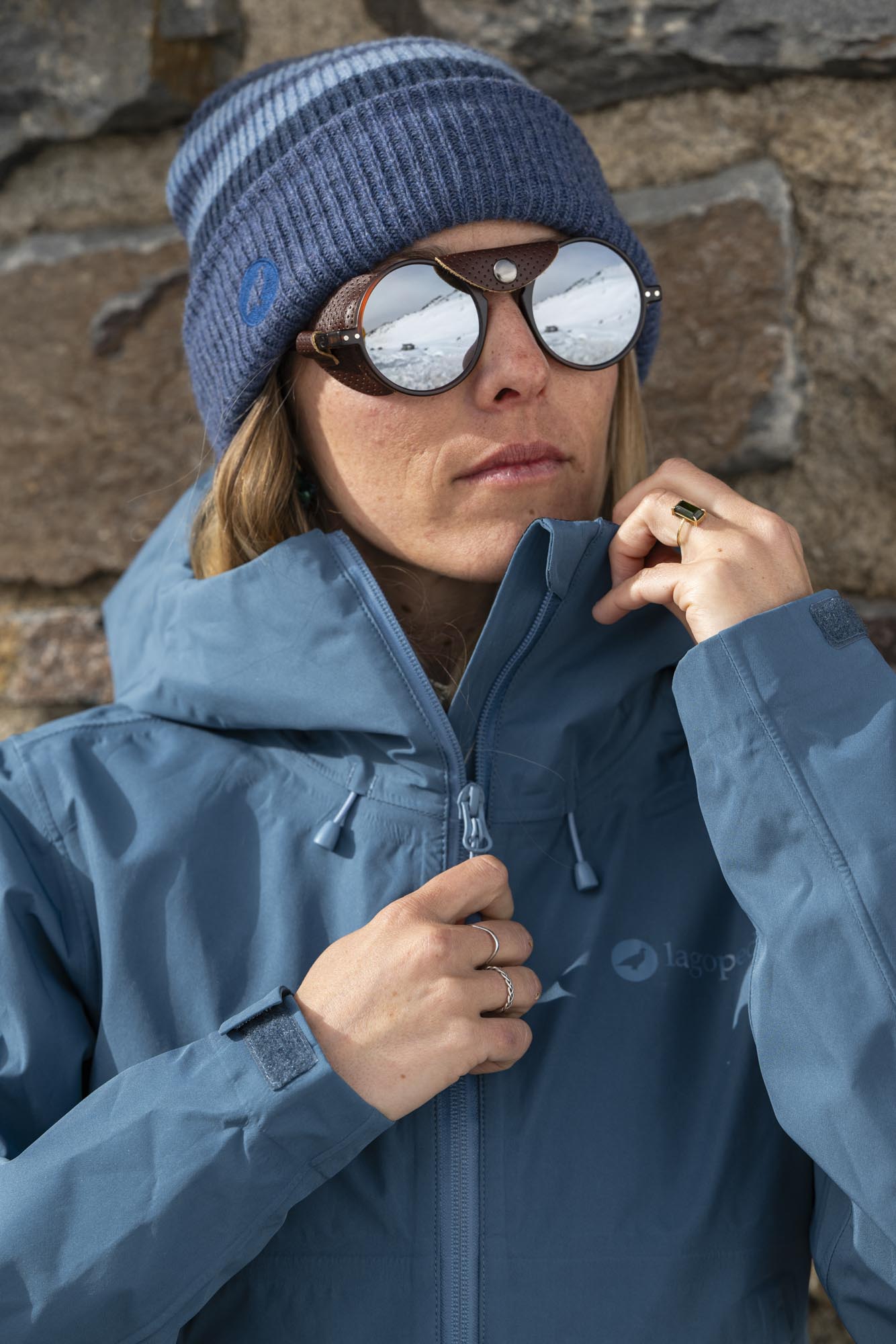
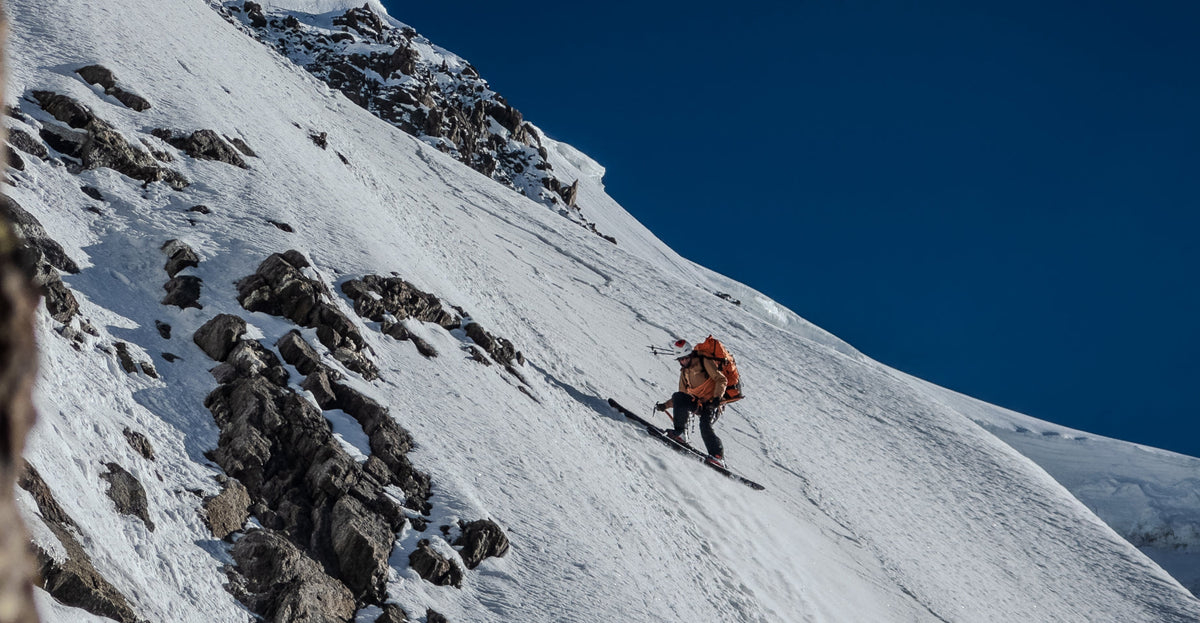
Tiphaine Dupérier on the RUPAL side of Nanga Parbat (8126m)
|
|
Time to read 9 min
Cart
To go further:
|
|
Time to read 9 min
From June 1 to July 15, 2024, Tiphaine Dupérier, member of the Lagoped Family, outstanding climber and skier, aims to make the first ski descent of the Rupal face of Nanga Parbat (8126m), accompanied by her partner Boris Langenstein. She shares with us the story of her expedition.
“Hi Christophe, Here we are back on the Internet. The expedition is over and we return without the summit. Unstable weather and probably a bad decision made us turn back on the second attempt. On this one, I regret not being able to commit more; it might have given us a chance to try the summit a second time. The first attempt (with David Goettler) we reached 7600m, but average acclimatization and a loooooong last day killed us! There, I am determined to try again next year with Boris and David (Goettler). The descent is just incredible and there’s a part missing."
"“Api! Six Api! We need a six!” Musa watches closely as the die stops on the board. No six. For a few days, Ludo has become a good way to pass the time at the base camp. We are at 3500m, at the foot of the Rupal face of Nanga Parbat and it’s warm enough that the mess tent is the perfect place for a game of Ludo. One might think success in this game is due to chance, but without strategy, it’s impossible to advance without losing your pieces. The comparison with our presence here in Pakistan didn’t occur to me at the first roll of the die. It was only when we descended from our second attempt, with a lingering bitterness in my gut, that I realized that here too, I wouldn’t have rolled the dream six and worse, I may not have had the right strategy."
In Pakistan, the name of the mountain Nanga Parbat can be translated as the "Naked Mountain," although it is also called "Sleeping Beauty." However, its reputation is not so fairy-tale-like, since since 1937, it has gained a darker notoriety after the disappearance of 7 climbers and 9 sherpas. It has become the "Killer Mountain." Tiphaine Dupérier knows this story well; she writes:
"The project is to make the first ski descent of the Rupal face of Nanga Parbat, the ninth highest peak in the world. At 4500 meters high, this face has a notorious reputation as a killer mountain with malevolent intentions. But as Pierre Chapoutot rightly points out in a very detailed document on this summit: « Here as elsewhere, it is not the mountain that kills: it is simply the conditions of its approach that increase or decrease the risks of suffering losses. » (Pierre Chapoutot, Nanga Parbat Recto-Verso. Cimes 2003)"
Nanga Parbat, first climbed in the summer of 1953 by an Austro-German expedition, is the second highest peak in Pakistan after K2. The summit has three gigantic faces: the east face of Raikot, the west face of Diamir, and the south face of Rupal.
For this new expedition with her friend Boris Langenstein, Tiphaine Dupérier chose the Rupal face, the most difficult route on Nanga Parbat. The Rupal face of Nanga Parbat is the highest in the world, stretching over more than four vertical kilometers from the ground. This face has never been skied before and is starting to attract the best skiers, beginning with Tiphaine Dupérier and Boris Langenstein.
Tiphaine Dupérier and Boris Langenstein know each other well; this is not their first expedition together, far from it! Together, the two guides have already made the first ski descents of Laila Peak (6096m), Spantik Peak (7027m), and the famous Nanga Parbat (8126m) via the Diamir face.
The skiing duo left France on June 1st, heading to Pakistan, a region now well known to Tiphaine Dupérier and Boris Langenstein. However, acclimatization remains an important step.
"Our strategy then. First, acclimatization. Arriving on June 4 at base camp, it’s the start of a risky process of altitude climbs, always with the same question: 'Do you think we’re ready?' For this first part, we are exploring the peaks opposite Nanga. The snow conditions are not what we would like, nor is the weather, which is starting to prove the forecasters wrong. Despite everything, and in conditions at the edge of our rules, we ski the north ridge of Rupal Peak, stopping just below the rocky summit at almost 5500m. To be able to claim an 8000m peak, a climb to 7000m and nights above 6000m are necessary. In this region of Nanga Parbat, we have no choice but to climb the monster (Nanga) to reach these altitudes. After three nights at 6000m and a climb to 6700m, on June 20, we assume our acclimatization is complete, without having checked off these prerequisites. Because the weather forecasts encourage us to try. They are what they are, but by far the best we have had!"
"The Schell route is the one we are considering. It is the 'easiest' on this side. It is also the first time I am attempting a route that goes to the other side of the mountain, which gives it a terribly committed character. We will divide the ascent into three camps: the first at 6000m, the second at 6800m, and the last at 7400m. For this first attempt, we are teaming up with David Goettler (who completed an oxygen-free Everest ascent in 2022). This is his fourth attempt on this route. David has a tight schedule, and we must take advantage of being three to be stronger."
At the foot of Nanga Parbat, Tiphaine and Boris meet David Goettler, a regular on Nanga Parbat and the Rupal face. In 2023, he aimed for the summit alongside Benjamin Védrines, but a bad day’s condition led them to turn back and prioritize the team spirit over the ambition of the current record holder for the K2 ascent without oxygen.
This year, he teamed up with Mike Arnold to conquer this route that he is determined to succeed on. After his departure, the American climber admits that the Rupal face is “hard to take in at a single glance. You have to stop and spend time, from east to west, scrutinizing this monstrosity.” Mike Arnold explains in particular that “this mountain demands everything, and a 4 to 5 day window was necessary to go up and down without extra oxygen.” He ends by thanking his climbing partner and wishing a good ascent to the new team: Tiphaine, Boris, and David.
On the first day, the three climbers navigate between storms and almost perfect snow conditions. “On June 26, the counter is at 0 at base camp, it’s 1:30 AM. Up to 6000m, the snow holds and it’s almost pleasant. Beyond that, it’s another story. We pedal through deep snow and without snowshoes the ascent is doomed to fail.”
After the first camp, the rope team is slowed by thick snow but can count on each member to take turns and reach the next camp. “Between camp 1 and camp 3 it’s already a little internal war, so we can barely imagine what it will be like higher up… The moment of crossing over to the Diamir side is impressive. The feeling of being on another mountain grips you and almost makes you nauseous because I know the summit is still far away. But everything is majestic. The clouds, we are above them. We can see the base camp on the other side. It’s immense. Come on, let’s focus, we still have work to do. Now we have to cross snow slopes that lead to a mixed ramp that will allow us not to lose altitude. It’s not extreme but the rock is bad and the whole thing is exposed. Boris and I are really exhausted. We know our acclimatization is borderline and our bodies are letting us know.”
On the fourth day, the summit was supposed to be within reach of the three climbers, but David Goettler later admitted that “everything seems much bigger on this mountain.”
"Unsurprisingly, at the end of this crossing, we discover the rest with the summit far too distant for our little legs, especially with that cursed powder snow. David also admits defeat. It’s too far, there’s too much elevation gain. There’s a little over 600m left and we have made a miserable 115m in 5 hours. The irony for a skier is that we have to climb back up to reach our tents and the other slope. Eight hours later, in a nice fog, we are back at camp 1, very tired."
Back at base camp, David GOETTLER explained that he would only be happy if he climbed this mountain in a style that stays true to his values. “There is always a certain frustration in having dedicated so much time and effort only to be turned back without reaching the summit, but I know that this is simply part of the journey: it’s part of what it means to ‘never stop exploring’.” Nevertheless, he acknowledges having made the right decision and is proud of the efforts made by the three climbers and the decisions taken.
David Goettler eventually leaves the French mountaineering duo, who want to give themselves a second chance to climb the summit and attempt the ski descent.
"For Boris and me, the schedule does not require us to return before July 21. So now that we are well acclimated, we have to try again. David is flying back to Europe. We are both old school, as Boris would say. In any case, we shouldn’t delay too long because warming is affecting the lower face and worsening skiing conditions. We need a week of rest, for the weather to stop acting treacherously, and maybe we can go beyond 7500m. Which will not happen.
We rested well and set off in what we thought was a good weather window. At camp 1, we received the new forecasts with disappointment. Our summit day was the worst: wind, snow. The next day we descended to base camp loaded like mules. Without fixed ropes, the descent is a real challenge when conditions are poor and especially with a good 25kg on your back. My stomach and brain are tied in knots, I feel like I made the wrong choice, that in fact it will be nice weather and we will be down there biting our fingers to the bone."
A few days after her return, Tiphaine Dupérier takes the necessary perspective on this new expedition and does not admit defeat.
"Chance? Strategy? Weather chance cannot be controlled, but strategy can be worked on. In general, the weather proved to be fickle in Pakistan this year. The game is not over and all my pieces are in place for the next round. I just need to refine my strategy and do a six next year."
We wish Tiphaine, Boris, David, and their future climbing partners to fulfill their dream and succeed in this ascent and descent in their own way, in alpine style, by ski or paraglider!
Tiphaine Dupérier
The skier, Tiphaine, is a guide in Tarentaise and originally from the Bauges Massif. She feeds off the very high altitude peaks that she climbs and skis down.


